Commissary Kitchen Guide: Find, Rent & Maximize a Shared Kitchen
A commissary kitchen costs $15–30/hour vs. $400,000–600,000 to build your own. Learn how to find, evaluate, and price your food from a shared commercial kitchen.
Commissary Kitchen Guide: Find, Rent & Maximize a Shared Kitchen
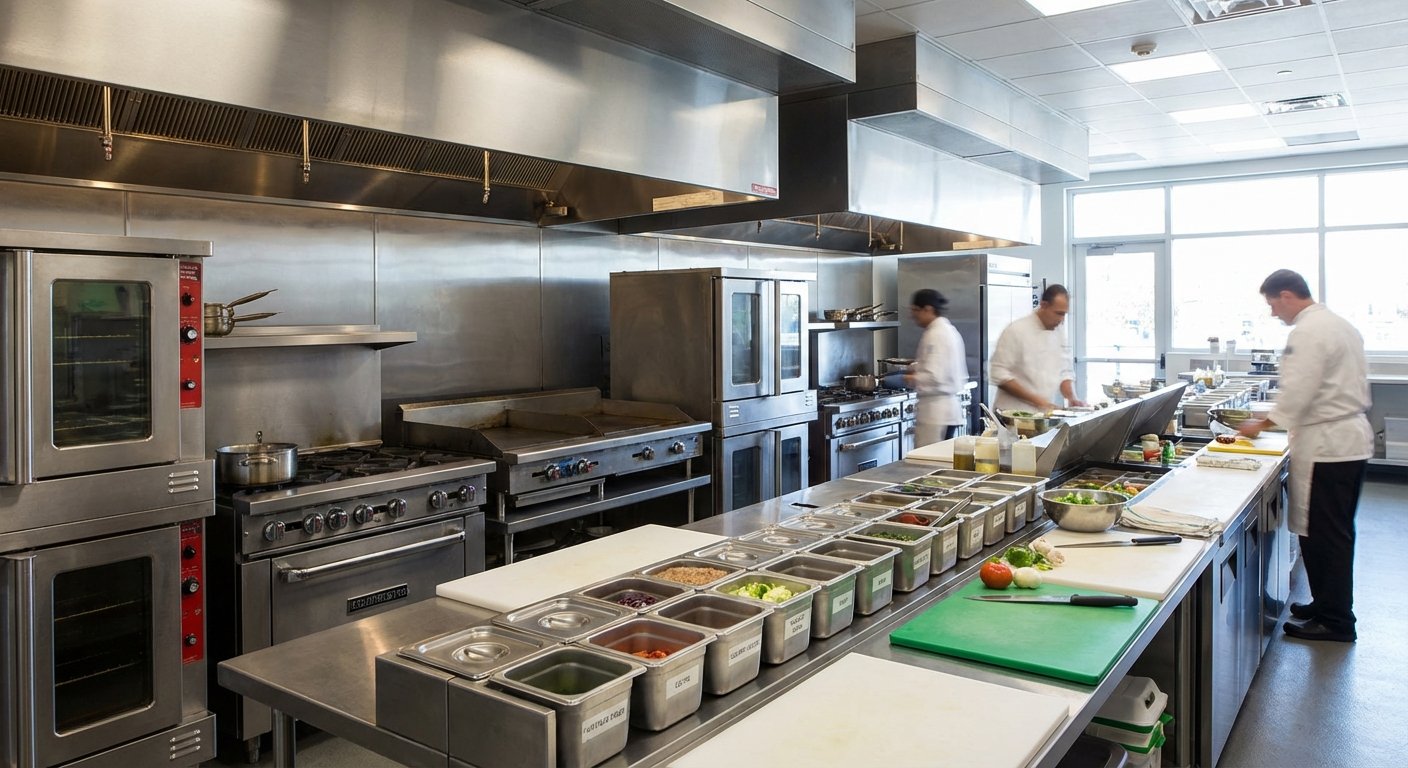
A commissary kitchen (also called a shared-use kitchen or incubator kitchen) is a licensed commercial kitchen that rents time and space to multiple food businesses. Food trucks, caterers, meal prep services, cottage food operators, and delivery-only concepts all use them.
The economics can be transformative: instead of $400,000–600,000 to build your own kitchen, you pay $15–30/hour to use someone else's.
What You Get with a Commissary Kitchen Rental
A standard commissary kitchen rental includes:
- NSF-certified commercial equipment (ranges, ovens, fryers, prep tables)
- Hand sinks and three-compartment sinks (required for commercial food prep)
- Walk-in cooler and freezer storage (usually by the shelf or cubic foot)
- Dry storage space
- Health department approval for the facility
- Commercial kitchen insurance coverage for the facility
Premium facilities may also offer:
- Packaging and labeling stations
- Photography studio for product shots
- Shared office space
- Loading docks for food truck operators
Finding a Commissary Kitchen
Web search. Search "[your city] commissary kitchen rental" or "shared commercial kitchen [city]." Most markets with 100,000+ population have multiple options.
National operators. Kitchen United, CloudKitchens, and similar operators have facilities in major markets. More expensive, but standardized quality and month-to-month flexibility.
Local restaurant incubators. Many cities have SBA-backed or city-funded kitchen incubators for food businesses. Often lower cost than private operators. Search "[city] food business incubator."
Existing restaurant kitchens. Many restaurants rent their kitchen during off-hours. Often the most affordable option—$12–20/hour with storage included.
Pricing: What to Expect
| Type | Hourly Rate | Monthly Membership |
|---|---|---|
| Basic shared kitchen | $15–25/hr | $200–400/month |
| Premium facility (major market) | $25–50/hr | $500–1,500/month |
| Ghost kitchen (dedicated station) | N/A | $1,500–5,000/month |
| Restaurant off-hours rental | $12–18/hr | Negotiated |
Monthly memberships are cheaper per hour if you're using 20+ hours/week consistently.
Storage billed separately: $50–150/month for a walk-in shelf, $100–250/month for a dry storage rack.
What to Evaluate Before Signing
Health department approval. Ask specifically: "Does using this kitchen as a commissary satisfy my health permit requirements?" Verify with your local health department before assuming.
Equipment match. Walk through the facility with your production list in hand. Does it have what your menu requires?
Storage access. Who else uses your storage space? Can it be locked? What happens when you run out of allocated space?
Hours of access. A 24-hour facility is worth more than one that closes at 10 PM.
Cleanliness and maintenance. Visit during peak hours. A health department shutdown of your commissary shuts down your business too.
Pricing Your Food from a Commissary
Include kitchen rental cost in your recipe costing. If you use 3 hours of kitchen time to produce 100 units at $20/hour, that's $0.60/unit in kitchen cost that many operators forget to include.
Full production cost model for a commissary-based caterer:
| Cost Category | % of Revenue |
|---|---|
| Ingredients | 28% |
| Kitchen rental | 4–5% |
| Labor | 20–25% |
| Packaging | 3–5% |
| Delivery/transportation | 2–4% |
| Total variable cost | 57–67% |
Net margin target should be 25–35% for commissary-based food businesses.
Frequently Asked Questions
Do I need my own food handler's permit even if the commissary is licensed?
Yes. The commissary's license covers the facility; your individual food handler's permit covers your operation within it. Requirements vary by state.
Can I produce and sell products from a commissary kitchen across state lines?
If shipping to other states, you'll need to comply with FDA regulations for food products, including labeling. Confirm whether the commissary's FDA registration covers your products.
How do I negotiate commissary kitchen rates?
Commit to a longer contract (6–12 months) in exchange for a lower hourly rate. Demonstrate consistent usage patterns. Multi-person memberships can also unlock volume discounts.
Ready to take control of your food costs? Try CostLab free for 14 days →
Track Food Cost on Every Dish — Automatically
CostLab.AI calculates food cost percentage in real time. Update one ingredient price and see the impact across your entire menu instantly.
Start Free Trial →