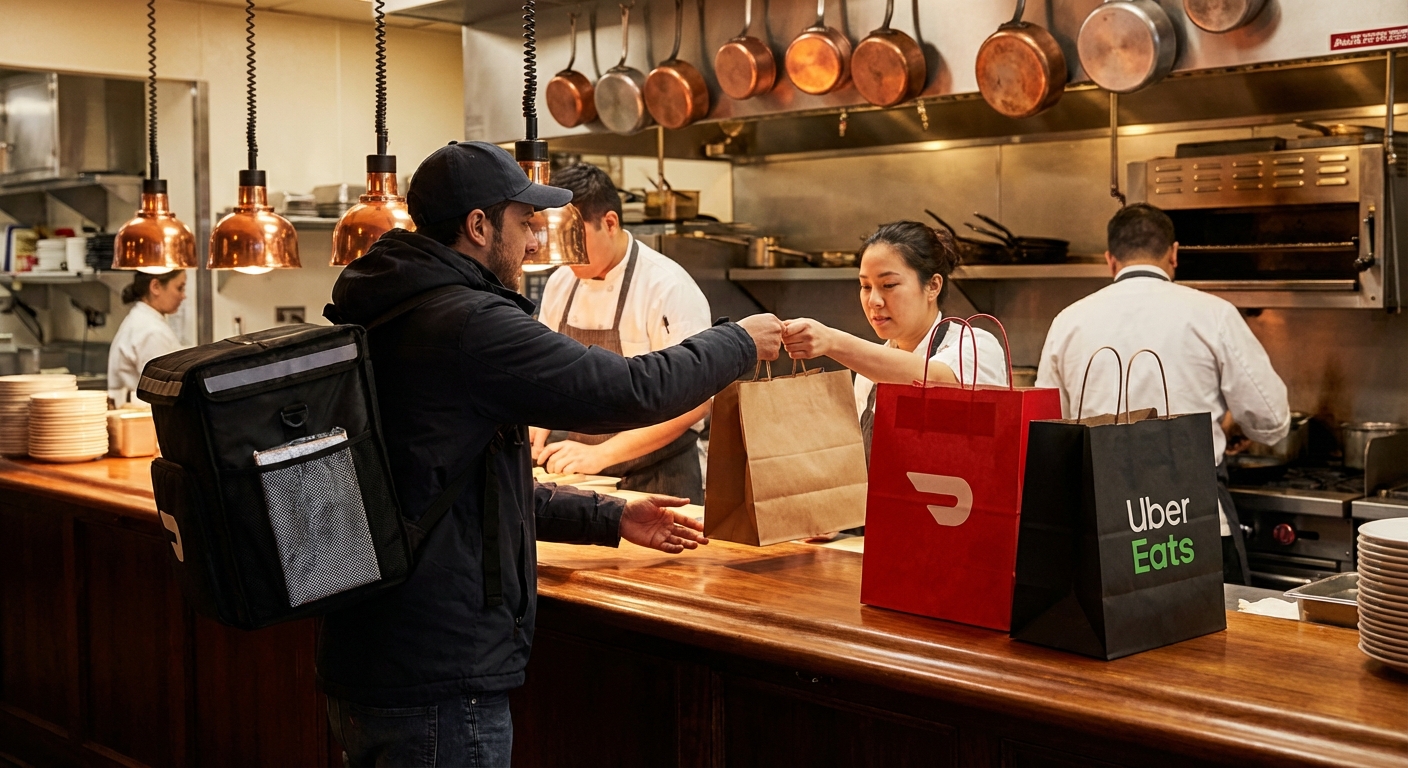
Are DoorDash and Uber Eats Worth It? Calculate Your Real Profit
Learn how to calculate real profitability on DoorDash and Uber Eats. See the full math on commissions, packaging, and labor — and when delivery actually makes sense.
Are DoorDash and Uber Eats Worth It? Calculate Your Real Profit
DoorDash and Uber Eats take 15–30% commission on every order. But that's just the start. When you factor in packaging, labor, and chargebacks, that $15 burger order might leave you $1–3 — or less. Here's how to calculate your real delivery profitability.
The Real Numbers Most Owners Never See
If a customer orders a $15 burger through DoorDash, how much do you actually keep?
Most owners guess $7–$9. The real answer is closer to $1–$3. And sometimes negative.
That's not a reason to quit delivery. But it is a reason to understand exactly what you're dealing with.
The Commission Math (What They Actually Charge)
| Platform | Commission Range | Notes |
|---|---|---|
| DoorDash | 15–30% | Basic (15%), Plus (25%), Premier (30%) |
| Uber Eats | 15–30% | Lite (15%), Plus (25%), Premium (30%) |
| Grubhub | 5–20% | + marketing fees on top |
The lower tiers (15%) come with trade-offs: less app visibility, no Dashpass/Uber One inclusion. Most restaurants end up on the 25–30% tier to stay competitive in search ranking.
On a $15 burger at 30% commission, you're paying $4.50 in platform fees alone.
The Real Math: What You Keep on One Order
| Line Item | Amount |
|---|---|
| Menu price | $15.00 |
| Platform commission (30%) | –$4.50 |
| Food cost (35%) | –$5.25 |
| Packaging (clamshell, bag, napkins) | –$1.20 |
| Your take-home | $4.05 |
That's a 27% margin on the delivery order — compared to ~65% gross margin on the same dine-in order.
Factor in 15 minutes of kitchen labor at $18/hr and you're at break-even or below.
The Hidden Costs That Kill Your Margin
Packaging
A disposable clamshell, paper bag, sauce cups, napkins, and utensils adds up to $0.80–$2.50 per order. Fine dining trying to do delivery hits $3–4 per package.
Chargebacks and Errors
Delivery errors happen constantly. Platforms often issue customer refunds automatically and charge it back to you. Budget 1–2% of delivery revenue for chargebacks.
Kitchen Labor Disruption
Delivery orders interrupt dine-in service flow. Research from the National Restaurant Association suggests delivery orders cost 15–20% more in kitchen labor per dollar of revenue compared to dine-in.
When Delivery Actually Makes Sense
Your menu travels well. Pizza, burgers, burritos, wings, noodles — these hold up. Fine dining mostly doesn't work for delivery.
Your kitchen has idle capacity. If you have dead time between 2–5pm, delivery fills that gap at positive contribution margin.
You can price delivery differently. A delivery menu at 15–20% higher prices can maintain similar margins to dine-in.
You treat it as customer acquisition. New customers who find you through DoorDash might become regulars. Track how many delivery customers convert to direct.
How to Improve Delivery Profitability
Raise delivery prices. Most platforms allow you to set delivery prices above in-house prices. A 15–20% increase covers the commission gap.
Negotiate your commission. Restaurants doing $10,000+/month in delivery revenue have leverage. Call your platform rep.
Build direct ordering. Every direct order (through your own site or app) saves 20–30% in commission. Tools like Owner.com, ChowNow, or Toast Online Ordering take commission-free orders.
Audit your delivery menu. Remove low-margin items that don't travel well. Focus on high-margin dishes that hold up.
FAQ
What percentage does DoorDash take from restaurants?
DoorDash charges restaurants 15–30% commission depending on plan (Basic, Plus, or Premier). Most restaurants end up on Plus or Premier (25–30%) for better app visibility.
How do I make delivery profitable on Uber Eats?
Raise delivery prices 15–20% above dine-in to offset commission. Cut delivery-unfriendly menu items. Negotiate your commission rate if you're doing significant volume.
Is it better to use DoorDash or Uber Eats?
Market share varies by city. In most markets, running both maximizes order volume but also complexity. Start with one, measure profitability, then add the second.
Conclusion
Delivery can work — but only if you know your actual numbers. Do the math on your top 5 delivery items this week. Price accordingly. And build toward direct ordering to reduce platform dependency.
Ready to take control of your food costs? Try CostLab free for 14 days →
Track Food Cost on Every Dish — Automatically
CostLab.AI calculates food cost percentage in real time. Update one ingredient price and see the impact across your entire menu instantly.
Start Free Trial →