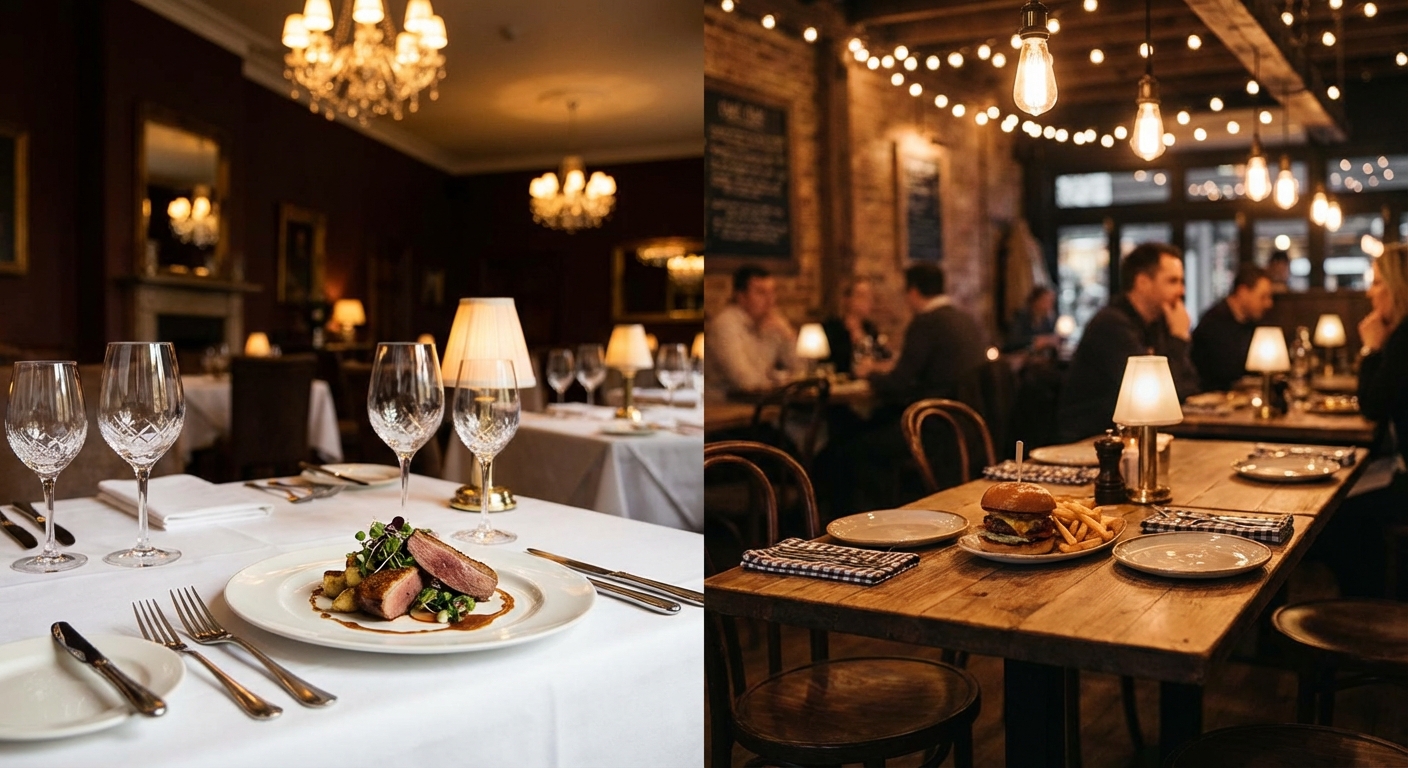
Fine Dining vs Casual Dining Margins: Real P&L Data
Fine dining vs casual dining margins differ more than most operators expect. Here's real P&L data comparing food cost, labor, and net profit across restaurant concepts.
Fine Dining vs Casual Dining Margins: Real P&L Data
Fine dining vs casual dining margins tell a surprising story: higher check averages don't automatically mean higher profits. Fine dining restaurants run lower food cost percentages but carry dramatically higher labor, décor, and occupancy costs. Casual dining operates with thinner average checks but more covers and faster table turns. Understanding these structural differences helps you benchmark your own operation — and set realistic expectations for your concept.
Food Cost: Where Fine Dining Has the Edge
Fine dining restaurants typically run food costs of 28–35% — often toward the lower end because premium ingredients command premium prices, and guests absorb the margin.
| Concept Type | Typical Food Cost % |
|---|---|
| Fine dining | 28–34% |
| Casual/polished casual | 30–36% |
| Fast casual | 25–32% |
| QSR | 28–35% |
The caveat: fine dining uses higher-cost ingredients, which means a 30% food cost on a $45 entrée represents more absolute dollars of ingredient cost than 30% on an $18 entrée. Waste becomes very expensive.
Labor Cost: Fine Dining's Biggest Burden
This is where fine dining gets squeezed. Fine dining restaurants staff heavily — experienced servers, sommeliers, expeditors, line cooks with specialization. Labor often runs 35–45% of revenue.
Casual dining labor typically runs 28–35%. Fast casual, with counter service models, often achieves 25–30%.
| Concept | Labor Cost % |
|---|---|
| Fine dining | 35–45% |
| Polished casual | 30–38% |
| Casual dining | 28–35% |
| Fast casual | 25–30% |
Fine dining restaurants partially offset this with higher revenue per labor hour — a server handling a $200 check generates more revenue per table than one handling a $45 check.
Occupancy and Overhead Costs
Fine dining typically occupies premium real estate with expensive build-outs, décor, and maintenance costs. Casual dining trades on volume with simpler environments.
Occupancy benchmarks (rent + NNN as % of revenue):
- Fine dining: 8–12% (high rent, lower covers)
- Casual dining: 5–8% (moderate rent, higher volume)
- Fast casual: 6–10% (variable by market)
A fine dining restaurant doing $2M in revenue in a space costing $25,000/month is running 15% occupancy cost — a significant drag.
Net Profit by Concept Type
After accounting for all costs, here's where concepts actually land:
| Concept | Net Profit % | Notes |
|---|---|---|
| Fine dining | 5–10% | High revenue per cover, high labor/overhead |
| Polished casual | 6–10% | Best balance of check and volume |
| Casual dining | 3–8% | Volume-dependent; labor-intensive |
| Fast casual | 6–12% | Strong if location/volume is right |
| QSR | 6–9% | System-dependent, royalties reduce franchisee margins |
Fine dining can generate exceptional absolute profits at scale — a $3M fine dining operation at 8% margin is $240,000 net. But the risk is concentrated: one slow month in a fine dining format hits harder than in casual.
Table Turns and Revenue per Square Foot
Casual dining outperforms fine dining on revenue per square foot because of faster table turns.
- Fine dining: 1.0–1.5 turns/night, $30–60 revenue/sq ft/year
- Casual dining: 2.5–4.0 turns/night, $200–400 revenue/sq ft/year
This is why casual and fast casual operators often focus on table turn speed as a KPI — it's a direct multiplier on revenue without adding a single seat.
FAQ: Fine Dining vs Casual Dining Margins
Does fine dining make more money than casual dining?
Not necessarily on a percentage basis. Fine dining can generate higher absolute profits with fewer covers, but it carries more risk and requires more capital. Casual dining often has more stable margins because volume provides a buffer.
What is the average net profit for a fine dining restaurant?
Fine dining restaurants typically net 5–10% after all costs. The range is wide because fine dining operations vary significantly in rent, staffing models, and revenue per cover.
Why is labor so high in fine dining?
Fine dining requires experienced, specialized staff — sommeliers, classically trained cooks, polished front-of-house. Service ratios are lower (more staff per guest), and training time is longer. These costs are structural, not optional.
Which restaurant concept is most profitable?
Polished casual and fast casual tend to show the strongest risk-adjusted returns — combining reasonable check averages with manageable labor and moderate occupancy. Fine dining can be more profitable in absolute terms but carries more concentration risk.
Ready to take control of your food costs? Try CostLab free for 14 days →
Track Food Cost on Every Dish — Automatically
CostLab.AI calculates food cost percentage in real time. Update one ingredient price and see the impact across your entire menu instantly.
Start Free Trial →