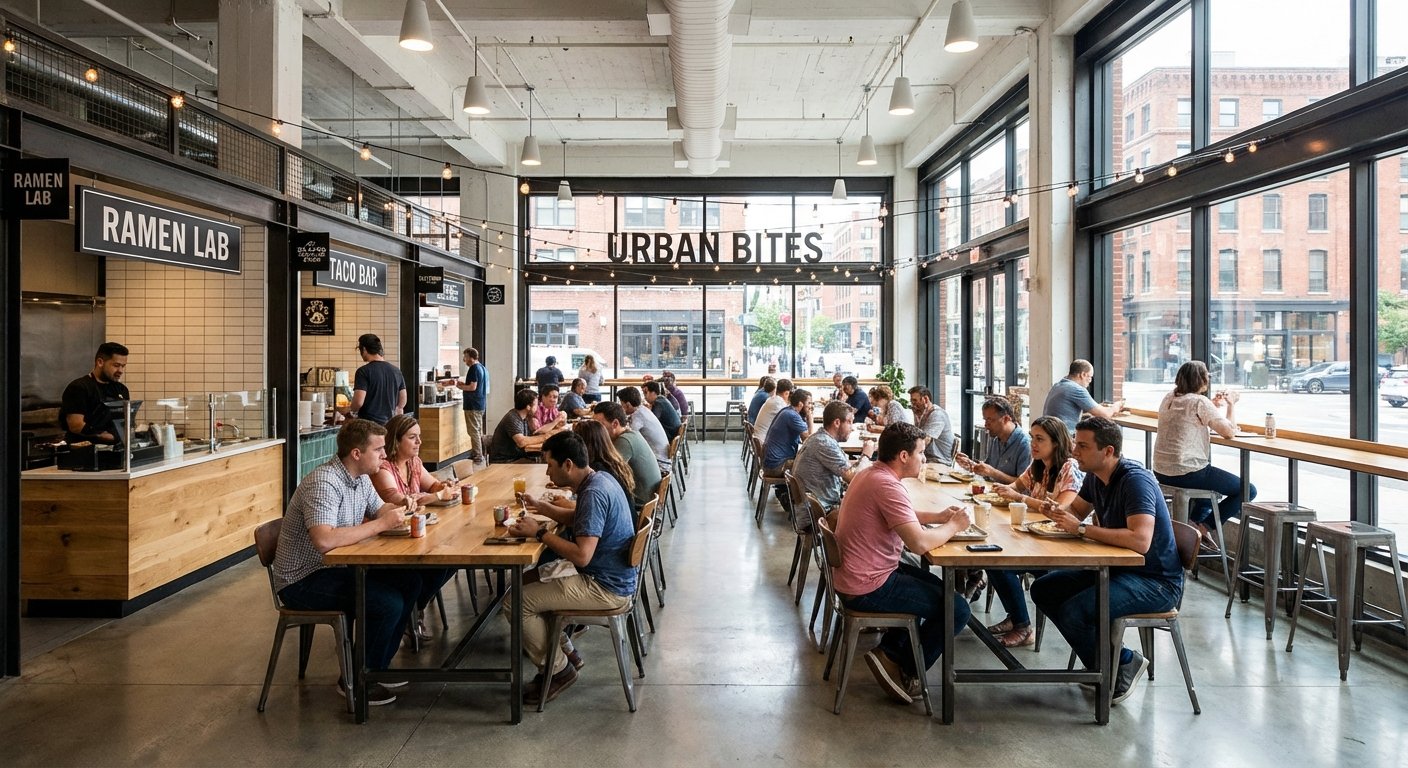
Food Hall vs Standalone Restaurant: Real Financial Trade-offs
Food hall stalls cost 20–35% of a standalone restaurant buildout—but revenue share and traffic risk are real. Here's the full financial comparison.
Food Hall vs Standalone Restaurant: Real Financial Trade-offs
Food hall vs standalone restaurant—this choice is increasingly common as food halls proliferate across US cities. From Chelsea Market in New York to Reading Terminal in Philadelphia to Pike Place in Seattle, the model attracts operators with lower startup costs, built-in traffic, and shared infrastructure.
But food halls have their own financial trade-offs that standalone operators don't face. Here's the complete comparison.
Defining the Models
Standalone restaurant. You lease or own your space, design and build it out, control your menu and concept completely, and keep all your revenue minus your own operating costs.
Food hall stall. You lease a smaller space (typically 100–400 sq ft) within a larger managed food hall. The hall operator handles common areas, marketing, and often shared seating. You run your stall and keep your revenue minus stall rent and any revenue share.
Startup Cost Comparison
| Item | Standalone (1,500 sq ft) | Food Hall Stall |
|---|---|---|
| Buildout/renovation | $200K–600K | $30K–120K |
| Equipment | $50K–150K | $20K–60K (often shared) |
| FF&E (tables, chairs, decor) | $30K–80K | $5K–15K |
| Working capital | $50K–100K | $20K–50K |
| Total | $330K–930K | $75K–245K |
A food hall stall can be launched for 20–35% of a standalone restaurant buildout cost. For a first-time operator or an unproven concept, this is significant risk reduction.
Revenue and Rent Structure
Food hall leases are structured differently from traditional restaurant leases:
Pure rent: $3,000–8,000/month for the stall space, no revenue share. Predictable cost, higher risk if sales are slow.
Revenue share: 10–18% of gross sales plus a base rent. The hall operator is incentivized to drive traffic. Your cost scales with performance but caps your upside.
Hybrid: Base rent of $1,500–2,500/month + 8–12% of revenue above a sales threshold.
Revenue share sounds operator-friendly but adds up fast. At 15% revenue share on $80,000/month in sales, you're paying $12,000/month to the hall operator—plus food cost, labor, and stall expenses.
The Traffic Question: What to Actually Ask
Food halls market themselves on foot traffic. The implicit promise: we bring customers; you focus on food. This is sometimes true and sometimes not.
Key question before signing: What's the average monthly sales per stall? Hall operators should provide this data. Better yet, talk directly to current stall operators.
A food hall in a major transit hub may deliver 800–1,200 covers/day across all stalls. A food hall in a neighborhood that hasn't taken off may deliver 80–120 covers/day. The difference is life-or-death for a stall operator with $5,000/month in fixed costs.
Operational Constraints of Food Hall Stalls
Limited menu. A 150 sq ft stall can execute 8–12 menu items with focus. This works well for specialized concepts (tacos, ramen, banh mi) and poorly for diverse menus.
Shared kitchen or limited storage. If the food hall has a shared prep kitchen, you're competing with other vendors for time and equipment.
No direct alcohol control. Most food halls handle beverage service centrally. You may not be able to sell beer, wine, or cocktails directly—eliminating a major margin driver.
Hall rules on hours and vendors. You'll be subject to the hall's operating hours, potential exclusivity clauses, and brand standards set by the hall operator.
Break-Even Analysis: Food Hall vs. Standalone
| Metric | Standalone | Food Hall Stall |
|---|---|---|
| Startup investment | $600,000 | $150,000 |
| Monthly fixed costs | $25,000 | $8,000 |
| Revenue needed to break even | $65,000–75,000/mo | $20,000–25,000/mo |
| Time to recoup investment (at $15K net/mo) | ~3.3 years | ~10 months |
The food hall path to initial break-even is dramatically faster—but the standalone has higher ceiling once volume is established.
Which Model Fits Which Operator
Food hall makes sense if:
- You're testing a concept for the first time
- Your concept is focused and executes well from a small footprint
- The specific hall has proven traffic at your target volume
- You have limited startup capital
Standalone makes sense if:
- You have a proven concept (prior pop-up, food truck, or catering success)
- You need alcohol revenue to hit your margin targets
- Your concept requires a controlled dining environment
- You have the capital for a proper buildout
Frequently Asked Questions
Can I transition from a food hall stall to a standalone restaurant?
Yes, and many successful independent restaurants started this way. A food hall stall is an excellent proving ground—if you can build a following and demonstrate consistent volume, you have the data to secure a standalone lease and potentially SBA financing.
How long are typical food hall leases?
1–3 years is common for food hall stalls, compared to 5–10 years for standalone restaurant leases. The shorter term reduces risk but also means less rent stability.
What's the minimum monthly revenue needed to survive in a food hall stall?
With $8,000/month in fixed costs and 30% food cost, you need roughly $15,000–20,000/month in revenue to break even. Anything less and the model doesn't work financially.
Ready to take control of your food costs? Try CostLab free for 14 days →
Track Food Cost on Every Dish — Automatically
CostLab.AI calculates food cost percentage in real time. Update one ingredient price and see the impact across your entire menu instantly.
Start Free Trial →