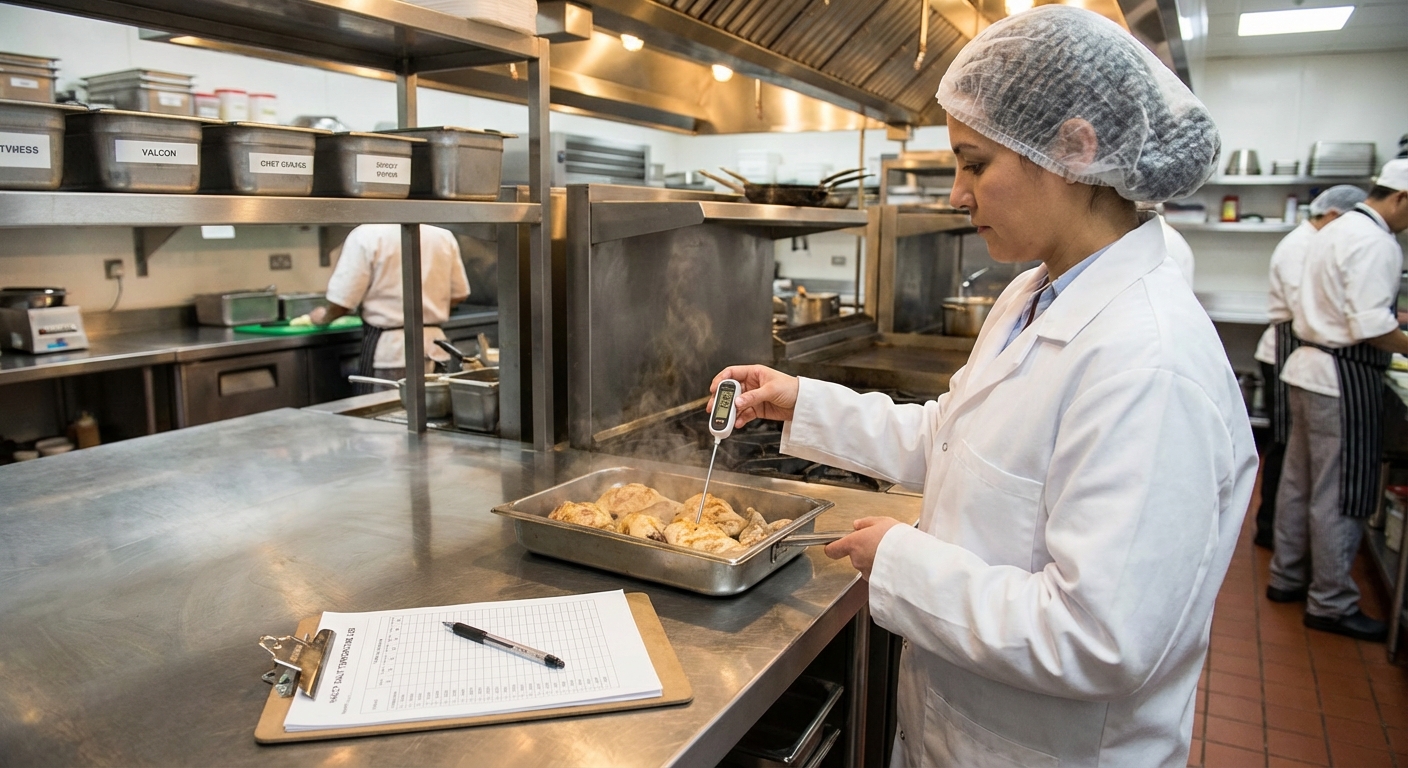
HACCP Food Safety Plan for Restaurants: Simple Guide
Build a HACCP food safety plan for your restaurant with this practical guide covering all 7 principles, critical control points, and daily log templates.
HACCP Food Safety Plan for Restaurants: Simple Guide
A HACCP food safety plan is required in most U.S. states and is your restaurant's primary defense against foodborne illness. HACCP — Hazard Analysis and Critical Control Points — was developed for NASA in the 1960s and is now the global standard for food safety management in commercial kitchens.
This guide breaks down all 7 HACCP principles in plain language with practical templates any independent restaurant can implement today.
Why HACCP Matters Beyond Compliance
HACCP is a legal requirement in most U.S. states. But compliance isn't the real reason to take this seriously. One foodborne illness outbreak can close your restaurant:
- Immediate: Health department shuts you down for investigation
- Short-term: Local news covers it. Your Google reviews tank overnight.
- Long-term: Some restaurants never recover.
A documented HACCP plan also protects you legally. Your records show exactly what temps you held food at, when you cooked it, and who checked it. That documentation is your shield.
The 7 Principles of HACCP (Plain English)
Principle 1: Identify Hazards
Walk through every step of your operation — receiving, storage, prep, cooking, holding, serving — and ask: What could go wrong here that would make a guest sick?
Hazards fall into three categories:
- Biological (Salmonella, E. coli, Listeria)
- Chemical (cleaning products near food)
- Physical (bone fragments, glass, metal)
Principle 2: Identify Critical Control Points (CCPs)
A CCP is any step where you can prevent, eliminate, or reduce a food safety hazard to an acceptable level. Cooking chicken to 165°F is a CCP. Keeping raw fish below 41°F is a CCP.
Principle 3: Set Critical Limits
Every CCP needs a measurable limit. Not "cook until it looks done" — that's not a limit. "165°F internal temperature" is a limit. Critical limits are non-negotiable.
Principle 4: Monitor Your CCPs
Decide how you'll measure each critical limit. Someone must be responsible — "everyone checks" means nobody checks.
Principle 5: Take Corrective Action
When a critical limit isn't met, you need a plan before the problem occurs. Example: Chicken from oven reads 158°F. Corrective action: cook 5 more minutes, recheck, document it.
Principle 6: Verify the System Works
Periodic reviews of your logs, equipment calibration, and occasional third-party audits. For independent restaurants, a monthly review with your kitchen manager covers this.
Principle 7: Keep Records
If it's not written down, it didn't happen. Keep your logs dated and signed. Store them for at least one year.
The 5 Critical Control Points for Most Restaurants
1. Receiving Temperatures
Check temperatures immediately when deliveries arrive:
- Refrigerated items: 41°F or below
- Frozen items: solid, no signs of thawing/refreezing
- Hot foods (if delivered hot): 135°F or above
2. Cold Storage
Walk-ins and reach-ins should hold 41°F or below. Check twice daily. Store food correctly: ready-to-eat foods on top, raw chicken on the bottom.
3. Cooking Temperatures
| Food | Minimum Internal Temp |
|---|---|
| Poultry (chicken, turkey) | 165°F |
| Ground beef | 155°F |
| Whole beef, pork, lamb | 145°F |
| Fish and shellfish | 145°F |
| Eggs for immediate service | 145°F |
4. Hot Holding
Food held for service must stay at 135°F or above. Check every 2 hours. Steam tables maintain temperature — they don't reheat. Food must reach 135°F before going on the steam table.
5. Cooling
Cool from 135°F to 70°F within 2 hours, then from 70°F to 41°F within the next 4 hours. Total: 6 hours maximum. Use shallow pans (2 inches deep), ice baths, and blast chillers.
A Simple Daily HACCP Log Template
| Date | Receiving Temp | Walk-in (AM) | Walk-in (PM) | Cooking Temp (item/temp) | Hot Holding | Corrective Actions | Initials |
|---|---|---|---|---|---|---|---|
Print this, post it in your kitchen, fill it out every day. One sheet per day in a binder. That binder is your documentation record.
How Often to Update Your HACCP Plan
Update when:
- You add new menu items (especially proteins or allergens)
- You change suppliers or equipment
- You have a food safety incident
- Health code regulations in your state change
Review the full plan every 6 months.
Frequently Asked Questions
Is a HACCP plan required by law for restaurants?
HACCP-based plans are required for most food manufacturers and increasingly for food service operations. In states like California, New York, and Texas, a written food safety plan is required for your food service permit.
How long does it take to write a restaurant HACCP plan?
A basic plan covering the 7 principles and your 4–6 critical control points takes 2–4 hours. Download a template from your state health department's website as a starting point.
What temperature should my walk-in cooler be?
38–40°F. This keeps food safely below the 41°F danger zone threshold while avoiding freezing issues with temperature-sensitive items. Check twice daily and document it.
What happens if an inspector finds no HACCP documentation?
Depending on your state, this could be a critical violation or a noted correctable deficiency. Having even a basic written plan is significantly better than having none.
Ready to take control of your food costs? Try CostLab free for 14 days →
Track Food Cost on Every Dish — Automatically
CostLab.AI calculates food cost percentage in real time. Update one ingredient price and see the impact across your entire menu instantly.
Start Free Trial →