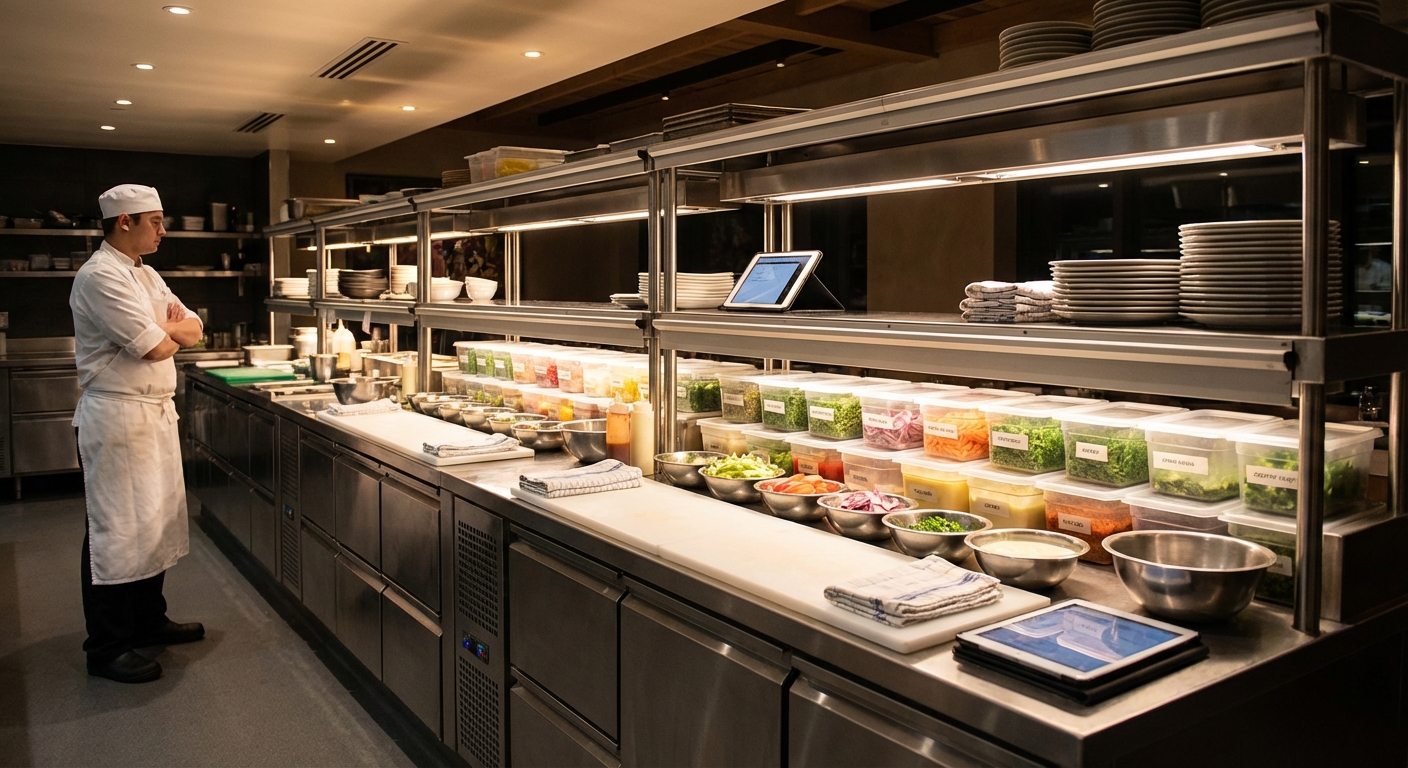
Mise en Place as a Management System for Profitable Kitchens
Mise en place isn't just a prep philosophy—it's a management system. Learn how organized kitchens use it to reduce cost and boost profit.
Mise en Place as a Management System for Profitable Kitchens
Mise en place — French for "everything in its place" — is how profitable restaurant kitchens run. Most operators think of it as a prep philosophy taught in culinary school. The best operators use mise en place as a management system that reduces food cost, labor waste, and service failures simultaneously.
This guide shows you how to take mise en place beyond the cutting board and apply it to your entire operation.
What Mise en Place Really Means at Scale
The surface layer: station setup — your knife, your towel, your containers, your prepped ingredients in position before service starts.
The deeper principle: operational readiness — every system, person, and resource is prepared before the moment of need.
Applied to restaurant management:
- Prep is done before service, not during — no scrambling mid-rush
- Quantities match forecasted demand — no over-prepping that becomes waste
- Every position has clear ownership — no confusion about who does what
- Costs are known before service — no guessing what margins looked like afterward
Mise en Place as a Prep Management System
Instead of a cook prepping "enough" of something, mise en place discipline means prepping a specific quantity based on sales data.
How to implement:
- Pull your POS data for each day of the week — average covers and top-selling items
- Calculate prep quantities for each station based on those numbers (not habit)
- Document par quantities on a physical or digital prep sheet
- Hold cooks accountable to hitting those numbers — no more, no less
What this eliminates: End-of-night waste from over-prepped proteins, sauces that get tossed, vegetable prep that didn't get used. Every ounce prepped but not sold is margin that disappeared.
Mise en Place as a Labor System
When prep is structured, labor is predictable. You can schedule prep cooks to specific tasks with specific time targets:
| Task | Who | Time Allotted |
|---|---|---|
| Butcher and portion proteins | Lead prep cook | 90 min |
| Sauce production | Prep cook 2 | 60 min |
| Vegetable mise en place | Prep cook 2 | 45 min |
| Stock and batch items | Anyone | 30 min active |
This structure lets you right-size your prep crew. If prep takes 3 hours for a slow Tuesday, you don't need 4 prep cooks in at 8 AM. Restaurants that implement structured mise en place typically reduce prep labor by 15–25% without reducing output.
Mise en Place as a Cost Control System
The financial discipline of mise en place is knowing your costs before service, not after:
- Every prepped component has a documented portion size and cost
- Line cooks know what each portion should weigh — and are held to it
- Yield is tracked (usable product after prep)
- Waste is logged so you can see where cost is leaking
A kitchen running true mise en place discipline has almost no mystery in their food cost.
How to Implement Mise en Place Culture
1. Start with one station. Pick your highest-cost station (usually proteins). Build a prep sheet, establish portion standards, track yield. Expand from there.
2. Make the prep sheet sacred. The prep sheet is the daily production plan. Every cook starts their shift reviewing it and ends checking off what's done.
3. Do a pre-service station check. 30 minutes before service: Is the mise en place complete? Are portions correct? Are temperatures right? Fix problems before they become service failures.
4. Debrief after service. 10 minutes after close: What ran out? What was over-prepped? Adjust tomorrow's quantities. This feedback loop is how mise en place improves over time.
Frequently Asked Questions
Is mise en place only for fine dining kitchens?
No — fast-casual and QSR operations benefit equally. In high-volume kitchens, organized mise en place is what enables fast service without errors. The principle scales to any format.
How does mise en place connect to food cost?
Directly. Portion control (a core mise en place discipline) is one of the top drivers of food cost variance. Inconsistent portioning creates 2–5% food cost variance that adds up to thousands per month.
What's a prep sheet and how do I build one?
A prep sheet is a daily list of items to prep, quantities needed, portion sizes, and responsible cook. Pull your sales data to calculate quantities, document portion standards from your recipes, and print it daily.
How long does it take to see results from better mise en place?
Most kitchens see measurable food cost improvement within 2–3 weeks of implementing structured prep and portion controls.
Ready to take control of your food costs? Try CostLab free for 14 days →
Track Food Cost on Every Dish — Automatically
CostLab.AI calculates food cost percentage in real time. Update one ingredient price and see the impact across your entire menu instantly.
Start Free Trial →