Building an Allergy-Friendly Menu: Operations and Marketing
32 million Americans have food allergies. Here's how to build an allergy-friendly menu with the right operations, staff training, and marketing strategy.
Building an Allergy-Friendly Menu: Operations, Training, and Marketing
32 million Americans have food allergies. Every year, 200,000 emergency room visits result from food allergic reactions. When a guest has a severe allergy and your restaurant fails to handle it correctly, consequences range from a medical emergency to a lawsuit.
But there's a business opportunity here too: a group of 8 where one person has celiac disease either finds a restaurant that accommodates her — or the whole party goes somewhere else. Handle it well, and you get the entire check.
The 9 Major Allergens You Must Know
The FDA requires labeling of 9 major food allergens (updated in 2023 to add sesame):
- Milk
- Eggs
- Fish
- Shellfish
- Tree nuts
- Peanuts
- Wheat
- Soybeans
- Sesame
These allergens account for ~90% of serious allergic reactions in the US. Know which of your dishes contain each one and document it in writing.
Operational Requirements for Allergy Safety
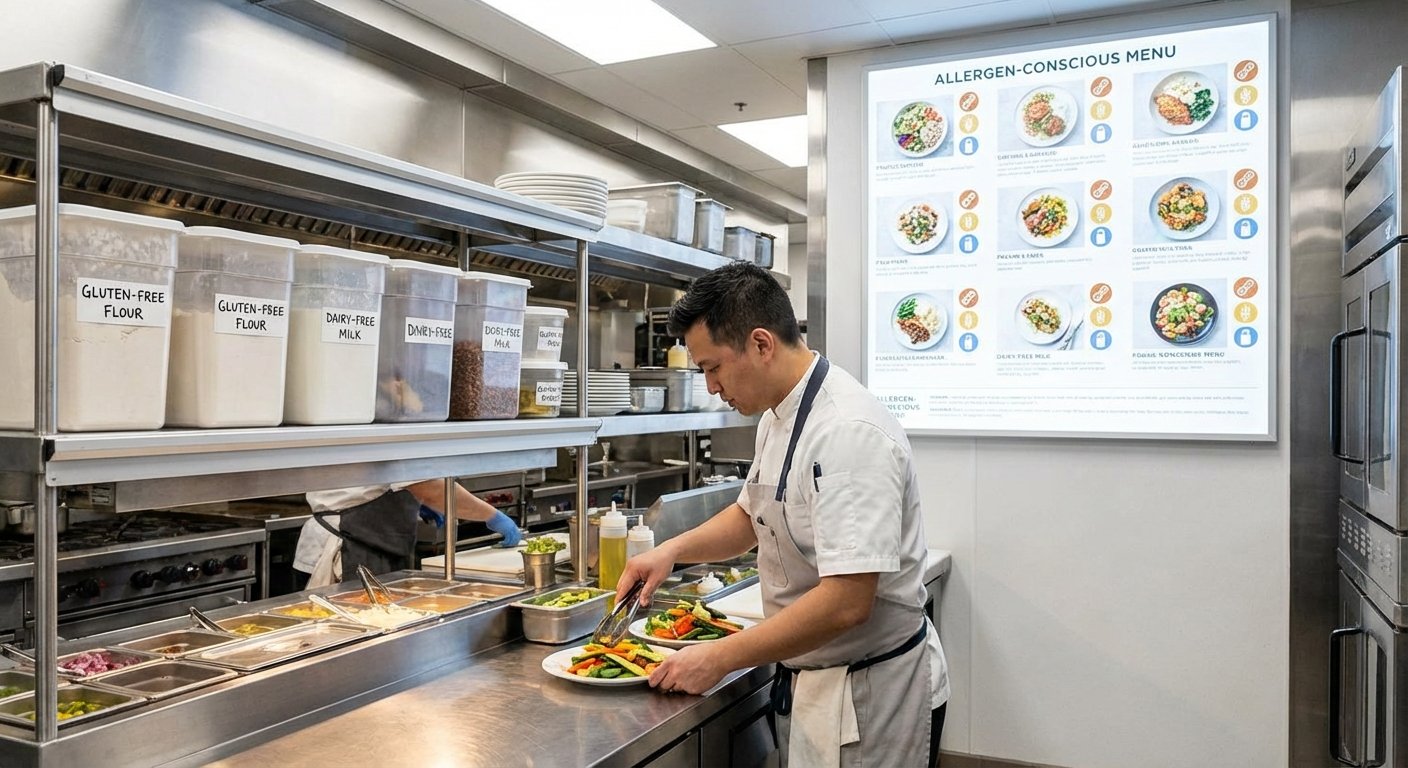
Separate prep areas. Cross-contamination is the most common cause of accidental allergen exposure. A "gluten-free" pasta dish cooked in the same water as regular pasta, or topped with a wheat-containing sauce, is not actually gluten-free.
Designated allergen-safe prep areas need:
- Dedicated cutting boards, pans, and utensils (color-coded or stored separately)
- Hand-washing protocol before and after allergen-contact prep
- Clean surfaces before any allergen-safe prep begins
Ingredient documentation. Know what's in every ingredient you purchase. Stocks, sauces, marinades, spice mixes, and processed ingredients often contain hidden allergens (soy in Worcestershire sauce, wheat in soy sauce, milk in some salad dressings). Build an allergen matrix: a table with every dish on one axis, every major allergen on the other. Review it every time your menu or suppliers change.
POS allergy flagging. Most modern POS systems (Toast, Square, Lightspeed) allow allergy flags on tickets. Use them. Train kitchen staff that an allergy flag means no shortcuts, no substitutions without verification.
Staff Training: The Critical Link
Your allergen procedures are only as good as your least-trained employee. Training must cover:
- The difference between a serious allergy and a preference ("I prefer not to eat gluten" vs. "I have celiac disease")
- Which menu items contain each major allergen
- What to say when a guest declares an allergy: "Let me check with our kitchen to confirm what's safe for you"
- The full procedure for handling an allergy order from entry to delivery
- What to do if a mistake is made (alert the guest immediately; don't serve the dish)
Document this training and conduct it with every new hire. Keep written records — this matters in any liability situation.
What You Can Safely Say (and What You Can't)
"Gluten-free" vs. "made without gluten": If your kitchen handles wheat products, you cannot guarantee zero cross-contamination. Say "made without gluten-containing ingredients" unless you have a truly separated protocol. If you do have full separation, you can say "gluten-free."
Menu disclaimer: Include language like: "We cannot guarantee any menu item is completely free of allergens due to shared kitchen equipment. Please inform your server of any allergies." This demonstrates reasonable disclosure, though it doesn't eliminate liability.
Never overstate: "Our kitchen is completely allergen-free" when it isn't is a misrepresentation that creates legal exposure.
Marketing Your Allergy-Friendly Capabilities
If you've built genuine capability to accommodate specific allergies:
- List allergen information on your website and online menu
- Tag your Google Business Profile with applicable accommodations (gluten-free options, vegan options)
- If you can safely accommodate severe peanut allergies or celiac disease, say so explicitly — these guests struggle to find safe restaurants and become fiercely loyal to the ones that handle it well
Research confirms: groups with one allergy member choose restaurants based on that member's ability to eat safely. Being the restaurant they trust is worth far more in lifetime value than the cost of your allergen training and systems.
Frequently Asked Questions
What are the 9 major food allergens restaurants must know?
The FDA requires awareness of: milk, eggs, fish, shellfish, tree nuts, peanuts, wheat, soybeans, and sesame (added in 2023). These account for approximately 90% of serious allergic reactions in the US.
How do I prevent cross-contamination in my restaurant kitchen?
Use dedicated color-coded cutting boards and utensils for allergen-sensitive prep, clean surfaces before allergen-safe cooking, require hand-washing between allergen-contact tasks, and use POS allergy flags to alert kitchen staff on every allergen order.
Can I say my dish is "gluten-free" if my kitchen handles wheat?
Not safely. If your kitchen handles wheat products, you cannot guarantee zero cross-contamination. Use "made without gluten-containing ingredients" instead. Only use "gluten-free" if you have a truly separated prep area and protocol verified by your team.
Ready to take control of your food costs? Try CostLab free for 14 days →
Track Food Cost on Every Dish — Automatically
CostLab.AI calculates food cost percentage in real time. Update one ingredient price and see the impact across your entire menu instantly.
Start Free Trial →