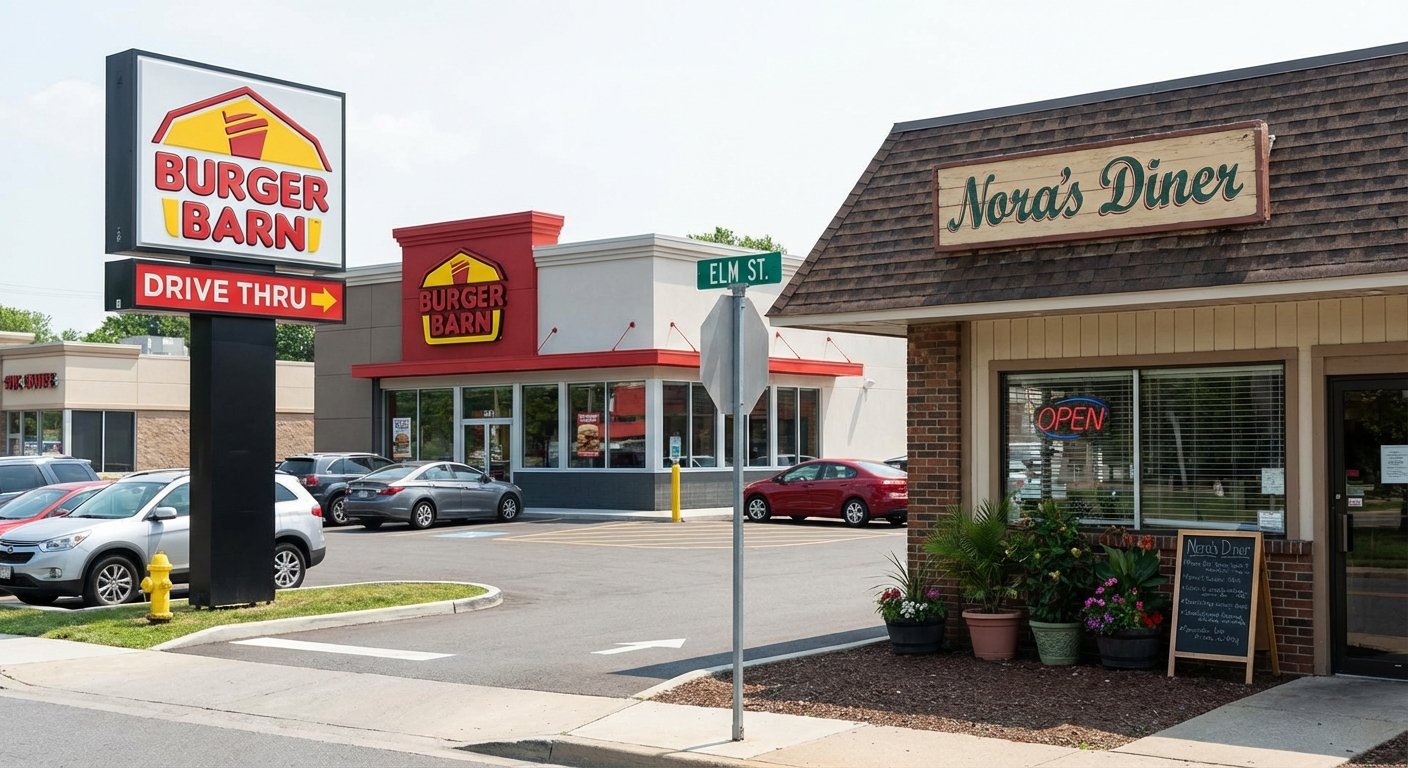
Restaurant Franchise vs Independent: The Real Financial Comparison
Franchise vs independent restaurant—the financial reality is more complex than you think. Royalties, purchasing power, failure rates, and break-even math compared.
Restaurant Franchise vs Independent: The Real Financial Comparison
The franchise vs independent restaurant debate is one of the most consequential decisions facing first-time operators. Franchises promise a proven system, brand recognition, and training. Independent restaurants promise freedom, flexibility, and keeping all the profits.
Both claims are partially true. Here's what the financial comparison actually looks like.
What Franchising Really Costs
Franchise investment varies dramatically by brand, but the structure is consistent:
Initial franchise fee: $25,000–$50,000 for most QSR and fast casual brands—paid upfront to get the license and initial training.
Total investment: McDonald's runs $1–2.3M. Subway runs $125,000–$470,000. A regional pizza franchise might be $150,000–$400,000. The investment includes buildout, equipment, signage, opening inventory, and initial working capital.
Ongoing royalties: Typically 4–8% of gross revenue, paid weekly or monthly. On $1M in annual sales, that's $40,000–$80,000/year leaving your business—forever.
Marketing/advertising fees: 2–4% of gross revenue to the national marketing fund. On $1M in sales, another $20,000–$40,000/year.
Total franchise overhead on $1M revenue:
- Royalties (5%): $50,000
- Marketing fees (3%): $30,000
- Technology fees: $6,000–12,000
- Total: $86,000–$92,000/year
That's money that stays in your business if you're independent.
What You Get for Those Fees
Brand recognition. Customers know what to expect at a Subway. Day-one traffic doesn't require years of brand building. This matters most in secondary markets and highway locations.
Proven system. The menu is developed, recipes are tested, training programs are written. If you follow the system, operations are predictable.
Purchasing power. Franchisees buy through the franchisor's approved supplier network at negotiated rates. For national brands, this can mean 15–25% lower food costs than an independent operator.
SBA financing access. Lenders finance franchise acquisitions more readily than independent startups because of documented success rate data.
The Independent Path: Risks and Rewards
Going independent means starting from zero on brand recognition, supplier relationships, recipes, and systems. But it also means:
- No royalty payments (saves $50,000–$80,000/year on $1M revenue)
- No mandated menu or supplier restrictions
- Full equity on any sale (no franchisor approval, no transfer fees)
- Freedom to adapt your concept to your market
The failure reality: Independent restaurants fail at higher rates than franchises in years 1–3. But survivor bias is significant—the franchises that are still actively franchising are the ones that worked.
Break-Even Analysis: Franchise vs. Independent
Assume two operators each investing $400,000 to open a restaurant doing $900,000/year in revenue at 8% net margin before franchise fees:
| Metric | Independent | Franchisee |
|---|---|---|
| Revenue | $900,000 | $900,000 |
| Net margin before fees | 8% ($72,000) | 8% ($72,000) |
| Franchise fees (8%) | $0 | $72,000 |
| Net profit | $72,000 | ~$0 |
| Break-even on $400K investment | 5.6 years | Never (at this revenue) |
The franchisee needs significantly higher revenue or lower non-franchise costs to justify the fees. The most successful franchisees operate at $1.2–2M+ annual revenue.
Who Should Buy a Franchise
- First-time operators in competitive markets where brand recognition reduces risk
- Operators targeting high-traffic highway or airport locations
- Operators who genuinely want a proven playbook and will follow the system
- Operators who can show that purchasing power savings offset royalty costs
Who Should Go Independent
- Operators with a distinct concept that doesn't fit a franchise model
- Experienced operators who already know their market and customer base
- Anyone who has run the math and the royalty burden makes economics untenable
- Operators who value the ability to sell without franchisor approval
Frequently Asked Questions
Can I negotiate franchise fees?
Occasionally. Existing multi-unit franchisees have more leverage for fee reductions on new units. First-time franchisees almost never negotiate initial fees or royalties.
Are there independent restaurants that outperform franchises financially?
Yes—consistently. The highest-earning independent restaurants significantly outperform comparable franchises because they retain the royalty overhead. The risk profile is different, not the ceiling.
What's the most important thing to check before buying a franchise?
Request the Franchise Disclosure Document (FDD) and examine Item 19 (Financial Performance Representations). Talk to at least 10 current and former franchisees before signing anything.
Ready to take control of your food costs? Try CostLab free for 14 days →
Track Food Cost on Every Dish — Automatically
CostLab.AI calculates food cost percentage in real time. Update one ingredient price and see the impact across your entire menu instantly.
Start Free Trial →