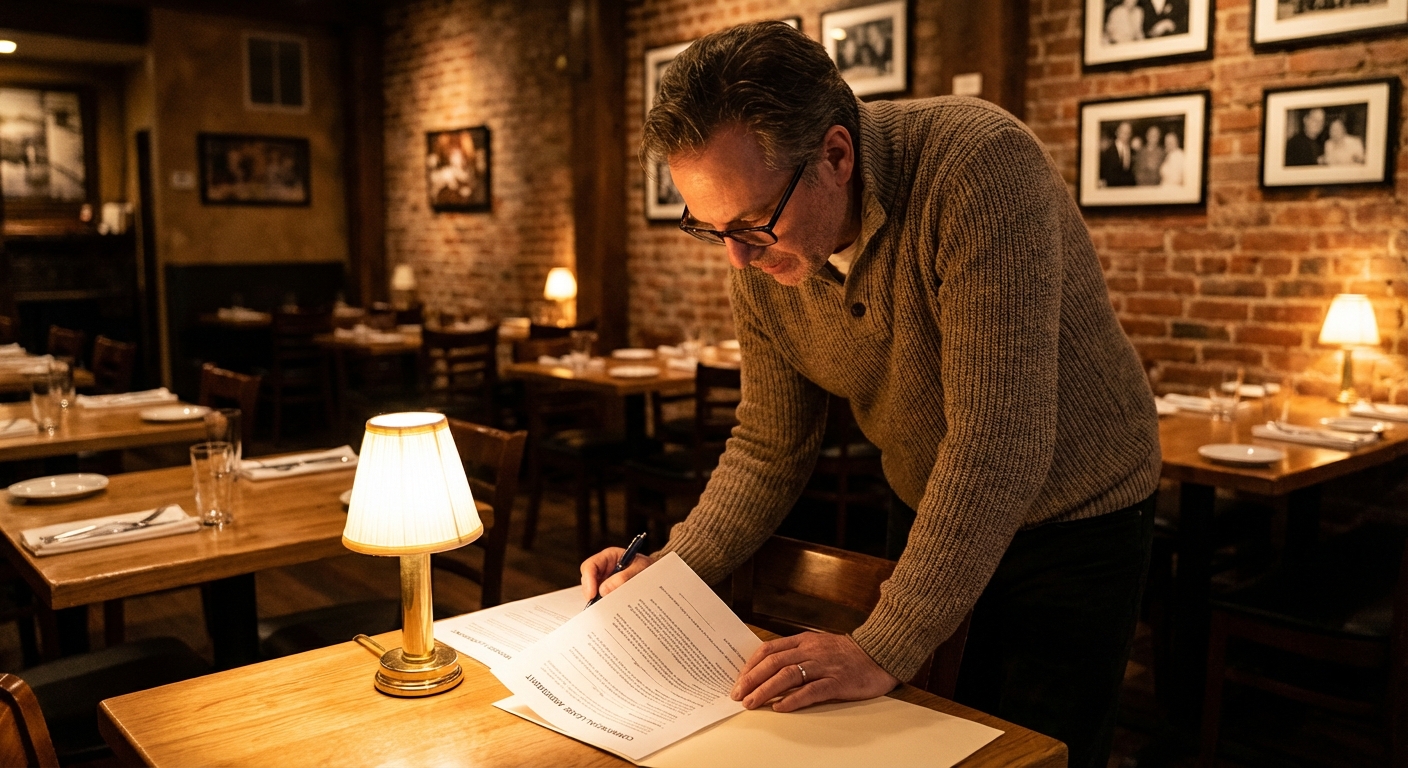
Restaurant Lease Negotiation: 7 Critical Clauses
Restaurant lease negotiation can save or cost you hundreds of thousands of dollars. Here are the 7 critical clauses every operator must understand before signing.
Restaurant Lease Negotiation: 7 Critical Clauses
Restaurant lease negotiation is one of the most important financial decisions you'll make. A 10-year lease on a 2,000 square foot space at $35/sq ft means $700,000 in rent payments — before utilities, CAM charges, or annual escalations. Get it wrong and you're locked into a deal that bleeds you dry. Get it right and your lease becomes a competitive advantage.
Clause 1: Base Rent and Escalation Schedule
The headline rent number matters less than the escalation schedule. A lease starting at $5,000/month with 4% annual escalations becomes $7,401/month in year 10. The same lease with 2% escalations becomes $6,095/month — a difference of over $150,000 across a 10-year term.
Negotiate for:
- Annual escalations of 2–3% (not 4–5%)
- CPI caps — escalations tied to the Consumer Price Index with a ceiling (e.g., "the lesser of CPI or 3%")
- Fixed-dollar increases rather than percentages when possible
Clause 2: Permitted Use
The permitted use clause defines what you're allowed to operate in the space. Landlords often write narrow definitions — "full-service Italian restaurant" — that prevent you from pivoting your concept.
Negotiate for:
- Broad permitted use language: "restaurant and food service operation of any type"
- The right to add catering, private events, and delivery operations
- Permission to change cuisine type without landlord approval
A restaurant locked into a narrow use clause can't pivot — and in today's market, pivoting is survival.
Clause 3: Personal Guarantee Terms
Most landlords require a personal guarantee, making you personally liable for rent if the business fails. The key is limiting the scope.
Negotiate for:
- Burndown provisions — the personal guarantee reduces each year the lease is in good standing (e.g., after 3 years of on-time rent, the guarantee drops to 2 years of remaining liability)
- Cap the guarantee — limit personal exposure to 12–24 months of rent rather than the full remaining term
- Entity-level guarantee only — push back on personal guarantee if your business has meaningful assets
Clause 4: Tenant Improvement Allowance
TI allowance is the landlord's contribution to your build-out. In strong markets, landlords offer $0. In favorable markets, TI can cover $50–100/sq ft or more.
How to negotiate TI:
- Get a competing offer — even if you prefer one space, a competing term sheet gives you leverage
- Ask for free rent during construction instead of cash if TI isn't available
- Structure TI as a loan if necessary — some landlords will amortize TI into rent over the lease term
- Always get TI in writing before signing
Clause 5: Assignment and Subletting Rights
Can you sell your restaurant without the landlord's consent? Can you sublease if you need to exit? Many leases give landlords the right to withhold consent — or recapture the lease — killing your exit options.
Negotiate for:
- The right to assign the lease to a buyer without landlord approval (or with approval not unreasonably withheld)
- Subletting rights in case of partial closure
- Protection against recapture clauses that let landlords take the space back when you want to assign
Clause 6: Exclusivity and Non-Compete Provisions
If you sign a lease in a multi-tenant center, exclusivity prevents the landlord from renting to a direct competitor in the same property.
Negotiate for:
- Category exclusivity — "Landlord will not lease to another pizza restaurant within the property"
- A radius clause if the landlord owns adjacent properties
- Clear definitions of competing concepts to avoid ambiguity
Clause 7: Early Termination and Co-Tenancy Rights
What happens if your anchor tenant closes? What if the center loses 30% of its tenants? Co-tenancy clauses give you rent reduction or exit rights when the center underperforms.
Negotiate for:
- Co-tenancy provisions tied to occupancy levels (e.g., if the center drops below 80% occupied, your rent reduces 15%)
- Early termination rights with defined penalties (typically 6 months' rent)
- Force majeure language covering public health events
FAQ: Restaurant Lease Negotiation
When should I start negotiating a restaurant lease?
Start negotiating at least 6 months before you need the space. Rushing lease negotiations is the single biggest mistake restaurant tenants make — landlords know when you're desperate.
Should I hire a restaurant real estate attorney?
Yes, always. A restaurant real estate attorney typically costs $1,500–$3,000 for lease review and negotiation. On a 10-year lease worth $700,000+, this is one of the highest-ROI expenses you'll make.
Can I negotiate rent down in the current market?
It depends on market conditions. In high-vacancy markets, landlords will often negotiate base rent, TI allowance, and free rent periods. In tight markets, the negotiation focuses more on clauses (escalation caps, personal guarantee limits, exclusivity) than the headline rate.
What is CAM, and how do I negotiate it?
CAM (Common Area Maintenance) charges are additional costs for maintaining shared spaces — parking, landscaping, exterior lighting. Always request a CAM cap (typically 3–5% annual increase) and the right to audit CAM expenses annually.
Ready to take control of your food costs? Try CostLab free for 14 days →
Track Food Cost on Every Dish — Automatically
CostLab.AI calculates food cost percentage in real time. Update one ingredient price and see the impact across your entire menu instantly.
Start Free Trial →