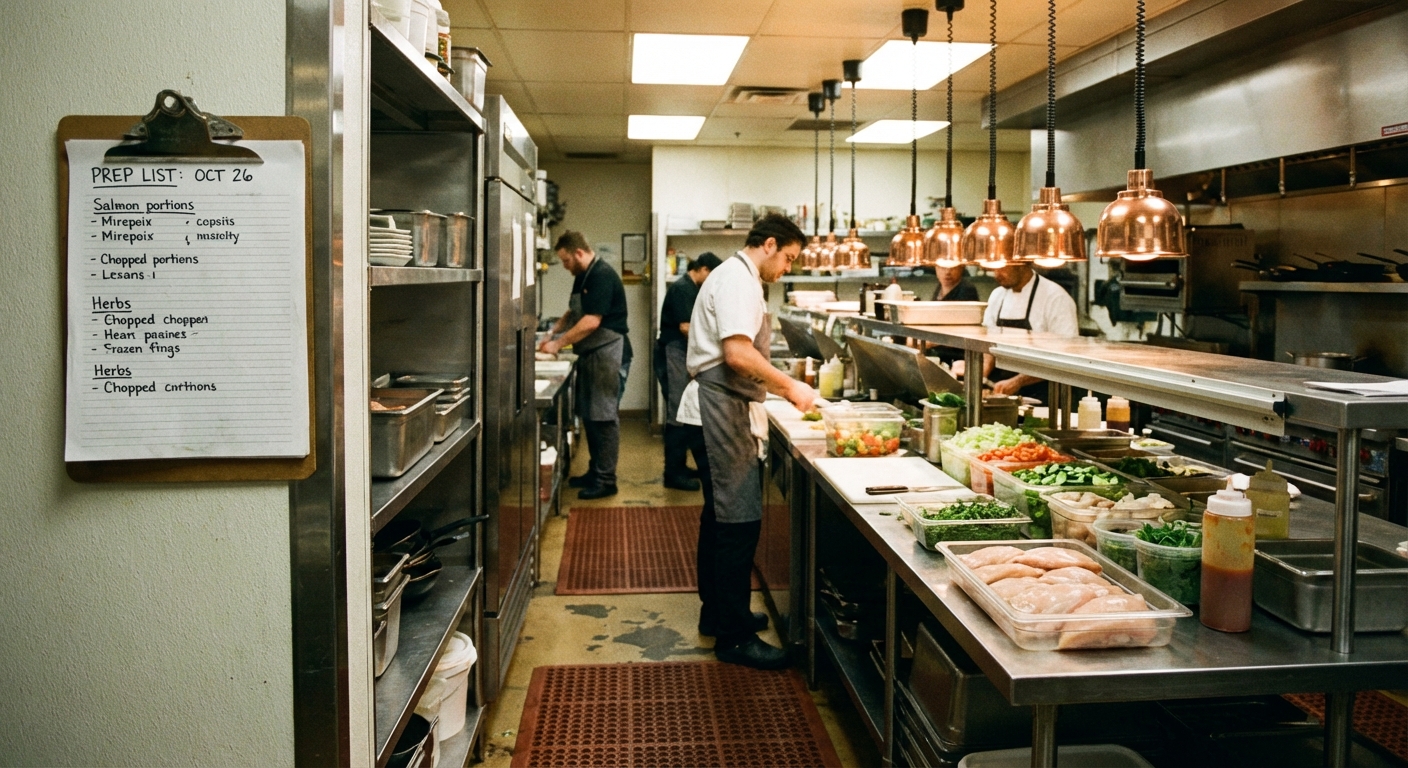
Restaurant Prep Sheet Guide: Cut Waste & Run a Tighter Kitchen
Learn how to build a restaurant prep sheet that reduces food waste, prevents shortages, and keeps your kitchen running like clockwork every shift.
Restaurant Prep Sheet Guide: Cut Waste & Run a Tighter Kitchen
A restaurant prep sheet is the daily production plan that tells your kitchen team exactly what to make, how much to make, and who's responsible. Without one, kitchens rely on gut instinct — and gut instinct costs money. This guide walks you through building a prep sheet system that actually gets used.
Why Most Kitchens Wing It (And What That Costs You)
Ask any line cook how much chicken they need to prep today. They'll give you a number. Ask where that number comes from. Watch them shrug.
Most kitchens run on yesterday's vibes — it rained last Tuesday, so we prep less. The problem isn't effort. The problem is no system.
If your kitchen over-preps by just 20% each day and your daily food cost is $400, you're throwing away $80 every single day.
$80/day × 365 days = $29,200/year in the trash.
Under-prepping is expensive too. Running out mid-service means 86'ing dishes, unhappy tables, and comped meals.
What Goes on a Prep Sheet
A good prep sheet has six columns. Nothing more.
| Column | What It Means |
|---|---|
| Item Name | What you're prepping (e.g., "Roasted Garlic") |
| Yield | How much usable product after prep |
| On-Hand Qty | What's already in the walk-in right now |
| PAR Level | Minimum you need going into service |
| Amount to Prep | PAR minus On-Hand |
| Responsible | Who's making it |
PAR level (periodic automatic replenishment) is the minimum quantity needed before service. If your PAR for Caesar dressing is 3 quarts and you have 1.5 quarts on hand, prep 1.5 quarts. Simple math, big impact.
How to Set PAR Levels That Actually Work
PAR levels are only useful if they're based on data, not guessing.
Step 1: Pull 4 weeks of sales data from your POS. How many portions of each menu item do you sell on an average Tuesday? A busy Saturday?
Step 2: Back-calculate ingredient usage. If you sell 80 burgers on Saturday and each burger uses 2 oz of special sauce, you need 160 oz of sauce for Saturday service.
Step 3: Add a safety buffer of 10–15%. Service is unpredictable. Build in a small cushion.
Step 4: Set different PARs for different days. Monday and Saturday have completely different volumes. Your prep sheet should reflect that.
Building the Prep Sheet Itself
You don't need software to start. A Google Sheet with the six columns above works fine. The key elements:
- Date and day of week at the top — PARs should vary by day
- Station breakdown — separate sections for cold prep, hot prep, and pastry
- Previous day's leftover column — helps your morning prep lead start fast
- Sign-off line — the prep lead initials when each item is complete
The most important rule: the prep sheet lives at the pass, not in a binder. If your team can't see it, they won't use it.
Prep Sheet by Station: What to Track
Different stations have different prep priorities:
Cold Station / Pantry: Dressings and sauces (by quart), salad mixes (by weight), sliced vegetables and garnishes.
Hot Line / Grill: Proteins (by weight — this is where the money lives), stocks and braises, roasted vegetables.
Fry Station: Breaded/battered items, blanched fries.
Pastry / Dessert: Plated dessert components, cake portions.
Common Prep Sheet Mistakes
Setting a single PAR for every day of the week. Your Friday needs are very different from your Tuesday needs. Set day-specific PARs.
Ignoring yield percentages. If your recipe calls for 5 lbs of roasted beets and you start with 5 lbs raw, you're short. Beets shrink. Account for yield loss in your prep calculations.
Not updating PARs seasonally. As your menu changes and business grows, PARs need to reflect reality. Review every 4–6 weeks.
Using volume instead of weight for proteins. A "bowl" of chicken varies by 30–50%. Use ounces or grams.
FAQ
What is the difference between a prep sheet and a recipe card?
A recipe card tells you how to make something. A prep sheet tells you how much to make. They work together — prep sheets set the quantity, recipe cards set the method.
How often should I update my prep sheet PAR levels?
Review PAR levels monthly, or anytime you notice consistent over- or under-prepping. If you're wasting more than 5% of a prep item consistently, your PAR is too high.
Should I use software or a spreadsheet for prep sheets?
A well-built spreadsheet works fine for most independent restaurants. Software like MarketMan or BlueCart can automate PARs and tie into your POS, but the fundamentals are the same.
Conclusion
A prep sheet isn't paperwork — it's profit protection. The restaurants that run tight kitchens aren't necessarily working harder. They're working with better systems.
Start with a simple Google Sheet this week. Set PARs based on real sales data. Put it at the pass. Your food cost will thank you.
Ready to take control of your food costs? Try CostLab free for 14 days →
Track Food Cost on Every Dish — Automatically
CostLab.AI calculates food cost percentage in real time. Update one ingredient price and see the impact across your entire menu instantly.
Start Free Trial →