
Restaurant Profit Margin: What's Normal and How to Improve Yours
Understand restaurant profit margins by concept type — QSR, fast casual, casual dining, fine dining. See the five levers that move your bottom line and how to use them.
Restaurant Profit Margin: What's Normal and How to Improve Yours
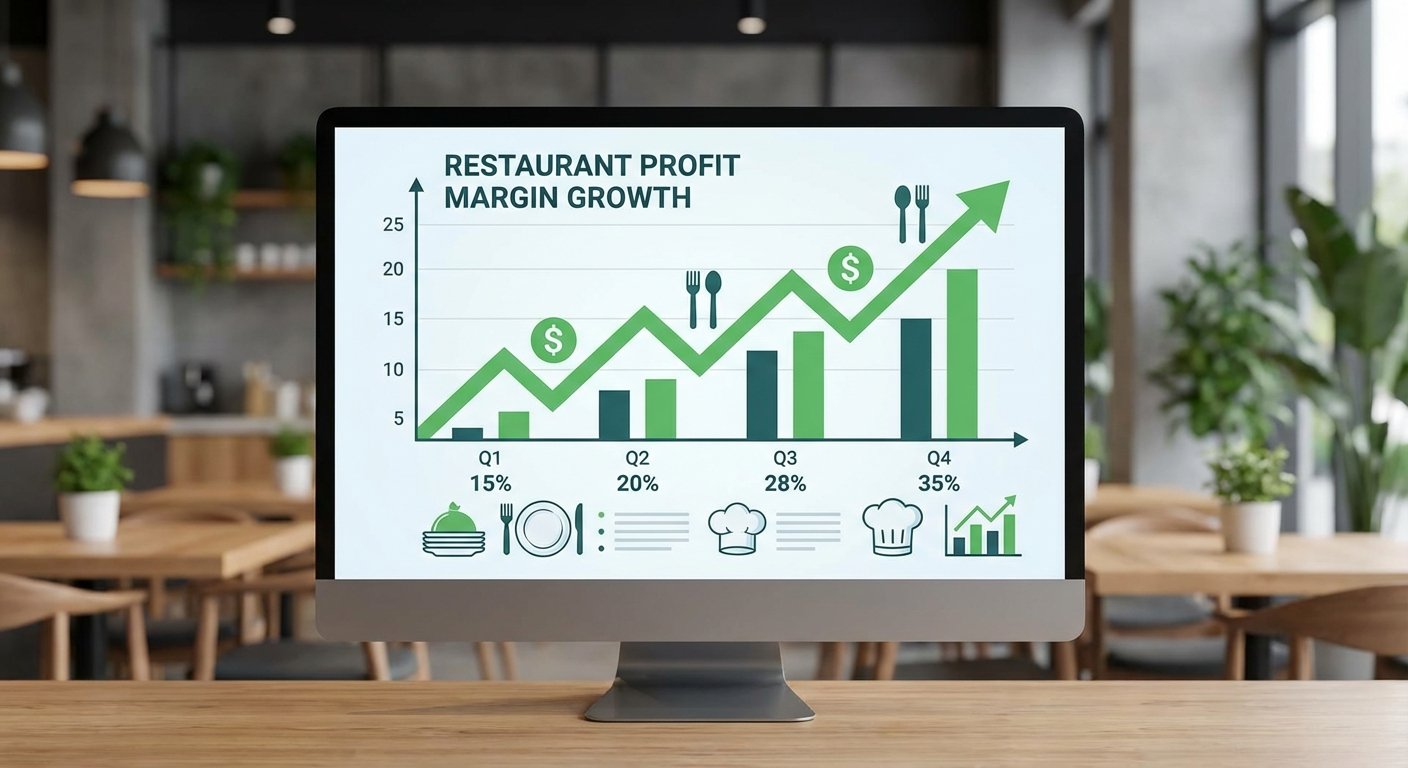
Restaurant profit margins are notoriously thin. The average full-service restaurant runs a net profit margin of 3–9%. Fine dining can push 10–15%. Fast casual often lands at 6–9%. That's not pessimism — it's context. In a 5% margin business, a 1-percentage-point improvement in food cost is a 20% increase in profit. The levers matter enormously.
The Reality of Restaurant Margins
Restaurants are a low-margin business by structure. High rent, high labor, highly perishable inventory, and intense competition compress profits. But understanding your margin structure is the first step to improving it.
What Determines Your Baseline Margin
Concept type is the biggest factor. Fast casual runs better margins than full service because labor is leaner and throughput is higher.
Location economics are the second factor. Rent as a percentage of revenue is a margin killer. Target rent at 6–10% of gross revenue. Above 12% is structurally very difficult to overcome regardless of how well you run the kitchen.
Volume matters because fixed costs (rent, insurance, management salaries) are the same whether you serve 80 covers or 120. Higher volume spreads those costs across more revenue — every incremental cover after break-even is disproportionately profitable.
Check average is the fastest lever. A restaurant serving 80 covers at $45 average ($3,600 revenue) has completely different economics than one serving 80 covers at $22 average ($1,760 revenue) — even with the same concept and labor structure.
Net Profit Margin Benchmarks by Concept
| Concept Type | Net Profit Margin Range |
|---|---|
| QSR | 6–9% |
| Fast Casual | 6–9% |
| Casual Dining | 3–9% |
| Fine Dining | 5–10% |
| Bar / Gastropub | 7–12% |
These are net margins — after all costs including rent, labor, COGS, utilities, insurance, and debt service.
The Five Levers That Move Your Margin
1. Food Cost %
The most controllable lever. Every percentage point improvement drops directly to the bottom line.
On $1M revenue, going from 33% to 31% food cost = $20,000 in additional profit. Same revenue, same staff, same menu. Just tighter cost controls.
How to move it: yield-adjusted recipe costing, portion control audits, waste tracking, supplier negotiation.
2. Labor Cost %
The largest cost line. Match staffing to actual sales forecasts. Overtime is the most expensive labor you can buy — 1.5x the hourly rate.
On $1M revenue, reducing labor from 36% to 34% = $20,000 in additional profit.
How to move it: build schedules from POS data not habit, cross-train for flexibility, track labor cost daily not monthly.
3. Check Average
Raise it through menu engineering, upsell training, and strategic pricing. A $2 increase in average check on 80 covers/day = $58,400/year in incremental revenue with no change in fixed costs.
How to move it: menu psychology, server training on feature items, wine and cocktail pairing programs, dessert programs.
4. Rent as % of Revenue
You can't easily change your lease — but you can grow revenue to make rent a smaller percentage. Or renegotiate at renewal.
Target: rent at or below 10% of gross revenue. If it's above that, revenue growth is your primary lever.
5. Mix Shift to Higher-Margin Revenue
Not all revenue is equal. Bar and beverage revenue carries 70–80% gross margins vs. 65–70% for food. Growing your beverage program — cocktails, wine by the glass, specialty coffee — directly improves overall margins.
A Simple Monthly Margin Review
Step 1: Pull last month's P&L. Step 2: Calculate: Food cost %, Labor cost %, Prime cost % (food + labor), Net profit %. Step 3: Compare each to your concept's benchmark range. Step 4: Identify the line item furthest above benchmark. Step 5: Set one specific improvement target for that line item this month.
Repeat monthly. Compound over a year.
FAQ
What is the average profit margin for a restaurant?
Full-service restaurants average 3–9% net profit. QSR and fast casual typically run 6–9%. Bars and gastropubs can reach 7–12%. Fine dining varies widely — strong check averages can push 10%+.
How can I improve my restaurant's profit margin?
Focus on your prime cost (food + labor combined). If it's above 65% of revenue, reducing either food cost or labor by 2 percentage points will have an immediate and measurable impact on the bottom line.
Is a 5% restaurant profit margin good?
For a full-service casual dining restaurant, 5% is solid — within benchmark range. On $1M in revenue, that's $50,000 in profit. The goal is to understand whether you're at 5% because of your concept's structure, or because of correctable inefficiencies pushing you below your potential.
Conclusion
Restaurant margins are thin by nature — but they're not fixed. The operators running 8–10% net margins in a 3–9% benchmark range are more systematic. They know their food cost percentage weekly. They schedule to sales forecasts. They run regular menu engineering reviews.
Calculate your net profit margin this month. Compare it to your concept's benchmark. Identify your biggest gap. That's where to start.
Ready to take control of your food costs? Try CostLab free for 14 days →
Track Food Cost on Every Dish — Automatically
CostLab.AI calculates food cost percentage in real time. Update one ingredient price and see the impact across your entire menu instantly.
Start Free Trial →