Selling Retail Products from Your Restaurant: Sauces, Rubs & Merch
Restaurant retail products—your house sauce, spice rub, or merch—can create a recurring revenue stream with margins up to 73%. Here's how to start.
Selling Retail Products from Your Restaurant: Sauces, Rubs & Merch
Every restaurant has something guests ask to buy: the house hot sauce, the signature spice rub, the branded tote bag, the coffee blend. Most restaurants say "I'm working on it" and never follow through. The ones that do create a recurring revenue stream with dramatically better margins than core food service.
Restaurant retail products are one of the highest-ROI revenue diversification opportunities available to independent operators. Here's how to identify, produce, and sell them.
Products That Work as Restaurant Retail
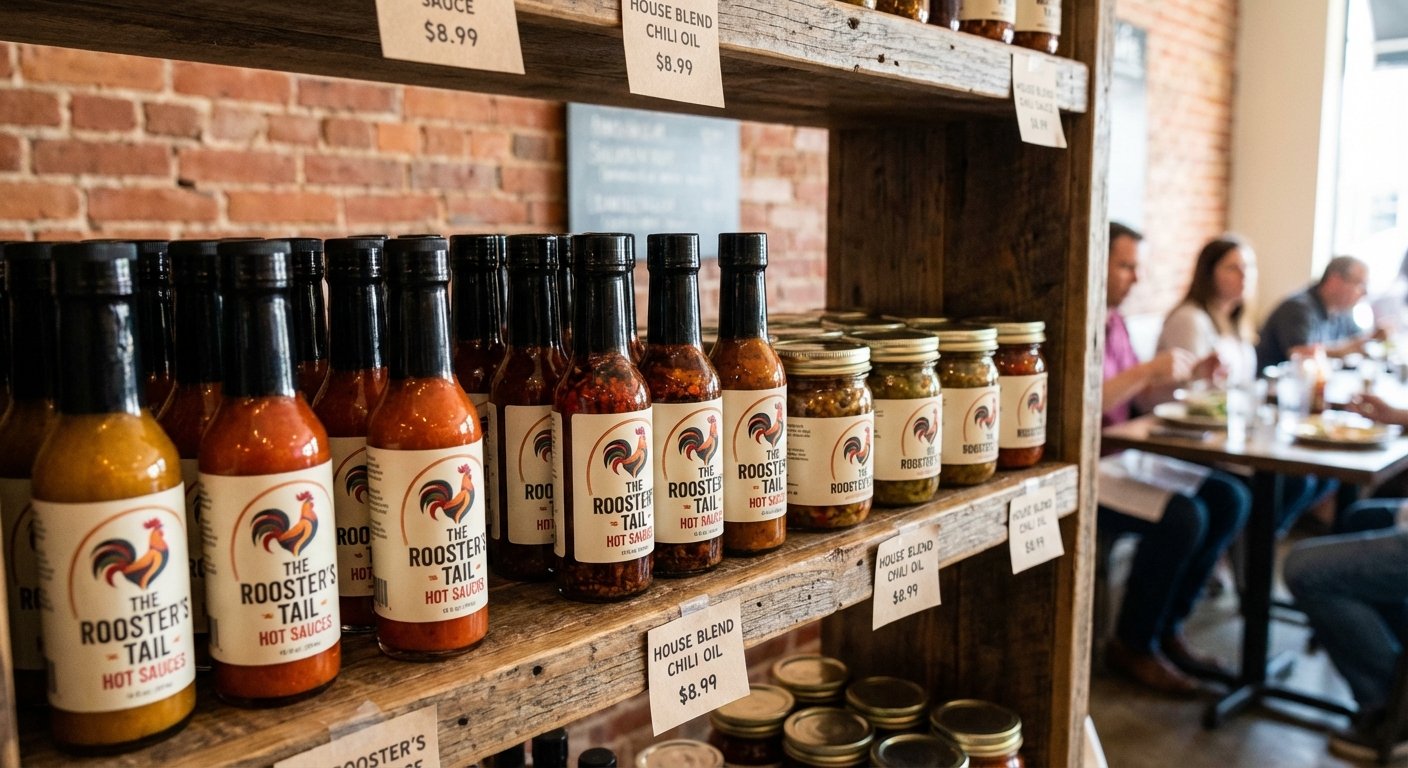
Condiments and sauces. House hot sauce, BBQ sauce, salad dressings, specialty salsas. The highest-margin retail category because ingredient cost is low and perceived value is high. Guests who love your BBQ sauce will buy a bottle for home—and become brand ambassadors when they serve it at their own dinner parties.
Dry goods and spice blends. Rubs, spice mixes, granola, specialty salt blends, coffee beans. Easy to package, long shelf life, excellent margins.
Branded merchandise. Trucker hats, T-shirts, tote bags, aprons. Lower margin than food (typically 40–60% gross margin), but turns regulars into walking billboards.
Specialty food products. Cookie mixes, pasta, jams, pickles. Higher complexity (FDA compliance for some products) but commands premium pricing.
The Economics of a Retail Sauce Line
Example: House hot sauce, 5 oz bottles
| Cost Item | Per Bottle |
|---|---|
| Ingredients | $1.80 |
| Glass bottle (bought in cases) | $0.55 |
| Cap, shrink band | $0.15 |
| Label (printed in runs of 500+) | $0.35 |
| Filling labor (1 hr per 50 bottles at $18/hr) | $0.36 |
| Total production cost | $3.21 |
| Retail price | $12.00 |
| Gross margin | 73.2% |
At 50 bottles/month: $600 revenue, $161 in production cost, $439 in gross profit—with almost no incremental labor beyond what you're already doing in the kitchen.
Regulatory and Labeling Requirements
Cottage food laws. Many states allow small-scale production and sale from a restaurant kitchen without a separate food manufacturing license, up to a revenue cap ($25,000–75,000 depending on state). Covers low-risk items: baked goods, jams, dried spices.
Commercial production license. If you're selling shelf-stable sauces or condiments in volume, most states require a processed food permit or commercial kitchen certification. Your restaurant kitchen may already qualify.
FDA labeling requirements. Products sold across state lines must comply with FDA labeling: ingredient list, allergen disclosure, net weight, manufacturer name and address, and a nutrition facts panel for most products.
Minimum label requirements (in-restaurant sales):
- Product name
- Net weight or volume
- Ingredients in descending order by weight
- Common allergens bolded
- Your business name and address
For in-restaurant sales under 200 units/month, state cottage food law is usually sufficient. If shipping to other states, consult a food law attorney before launching.
Co-Packers: When to Outsource Production
If volume grows beyond what you can produce in-house, co-packers are licensed food manufacturing facilities that produce your recipe at scale.
- Production cost: $3–8/unit at 1,000+ unit minimums
- Handles filling, capping, labeling under their FDA registration
- You provide the recipe and packaging specs
In-house production makes sense until you're moving 500+ units/month.
Getting Your Products in Front of Customers
In-restaurant sales first. At-register display alone can move 30–80 bottles/month without additional marketing. Train servers to offer when guests compliment a dish.
Local specialty grocery stores. Take samples to the buyer at your nearest specialty food retailer. They'll take a 35–45% margin—lower net for you, but 5–10x your in-restaurant volume.
Online sales via your website. A simple Shopify or WooCommerce store adds national reach.
Frequently Asked Questions
Do I need a separate business entity for my retail products?
Not necessarily, but it's worth discussing with your accountant. Many restaurants run retail products under the same entity. If volume grows significantly, a separate LLC may make sense for liability isolation.
How do I price retail products vs. grocery store brands?
Don't compete on price—compete on story. Your house sauce commands a premium because it comes from a real restaurant, made by real cooks. Price 20–40% above comparable mass-market products.
What's the easiest retail product to start with?
Dry spice blends and rubs: long shelf life, no refrigeration required, simple production, low regulatory hurdles in most states.
Ready to take control of your food costs? Try CostLab free for 14 days →
Track Food Cost on Every Dish — Automatically
CostLab.AI calculates food cost percentage in real time. Update one ingredient price and see the impact across your entire menu instantly.
Start Free Trial →