Standardized Recipe Writing to Control Food Cost
A standardized recipe is your most powerful food cost control tool. Learn how to write one that delivers consistent portions and predictable margins.
Standardized Recipe Writing to Control Food Cost
A standardized recipe is one of the most powerful food cost control tools in a restaurant's arsenal — and most independent operators don't have them. The difference between a regular recipe and a standardized one is the difference between a food cost you control and one that controls you.
This guide shows you exactly what a standardized recipe includes, why it matters financially, and how to write one that actually sticks.
A Recipe Is Not a Standardized Recipe
Your chef has a recipe for the crab pasta. It's in his head, mostly. Sometimes on a notepad. It says "handful of parmesan, splash of cream, season to taste."
That's a recipe. Here's why it's costing you money:
- A "handful" from Chef Marco is 2 oz. A "handful" from the Tuesday prep cook is 3.5 oz.
- A "splash of cream" is 1 oz on a normal day and 4 oz when someone's in a hurry.
- "Season to taste" means the dish costs a different amount every time it leaves your kitchen.
Over 200 servings per week, that 1.5 oz parmesan variance costs $1,170/year on one topping on one dish. Multiply that across your full menu and you've found your food cost problem.
What a Standardized Recipe Must Include
A true standardized recipe has seven components:
- Recipe name and category
- Exact yield — how many portions this recipe makes (e.g., "serves 24")
- Portion size — weight or volume of one serving (e.g., "8 oz plated")
- Ingredient list with exact measurements by weight — not "one chicken breast" but "6 oz chicken breast, boneless skinless"
- Step-by-step preparation instructions — written for the cook who's never made this dish
- Plating instructions — where does the protein go, what does the garnish look like, which plate
- Cost per portion — ingredient cost ÷ yield, calculated with current prices
How to Calculate Recipe Cost Per Portion
Cost Per Portion = Total Ingredient Cost ÷ Number of Portions
Step 1: List every ingredient with exact weight/volume used in the batch.
Step 2: Calculate the cost of each ingredient based on purchase price and yield.
- Purchase price: $4.00/lb for chicken
- Yield after trimming: 85% (1 lb bought = 0.85 lb usable)
- As-purchased cost per usable lb: $4.00 ÷ 0.85 = $4.71/lb usable
- For a 6 oz portion: $4.71 × (6/16) = $1.77 for the chicken
Step 3: Add up all ingredient costs. Step 4: Divide by the number of portions.
Step 5: Calculate food cost percentage:
Food Cost % = Cost Per Portion ÷ Menu Price
If your crab pasta costs $4.80 to make and sells for $18, your food cost is 26.7%.
Why Yield Matters More Than You Think
Yield is the percentage of a purchased ingredient that becomes usable product after trimming, cooking, or portioning.
Common yields:
- Beef tenderloin after trimming: ~75%
- Whole chicken breakdown: ~65–70% usable meat
- Potatoes after peeling: ~85%
- Fresh spinach after wilting: ~40%
If you don't account for yield, your recipe costs are wrong. You'll think a dish costs $5.00 when it actually costs $6.50 — and every menu price you set based on that number is wrong.
Getting Cooks to Follow Standardized Recipes
Writing the recipes is 20% of the work. Getting your team to follow them consistently is 80%.
Print and laminate. Physical recipes at every station get used. Digital recipes on a shared drive don't.
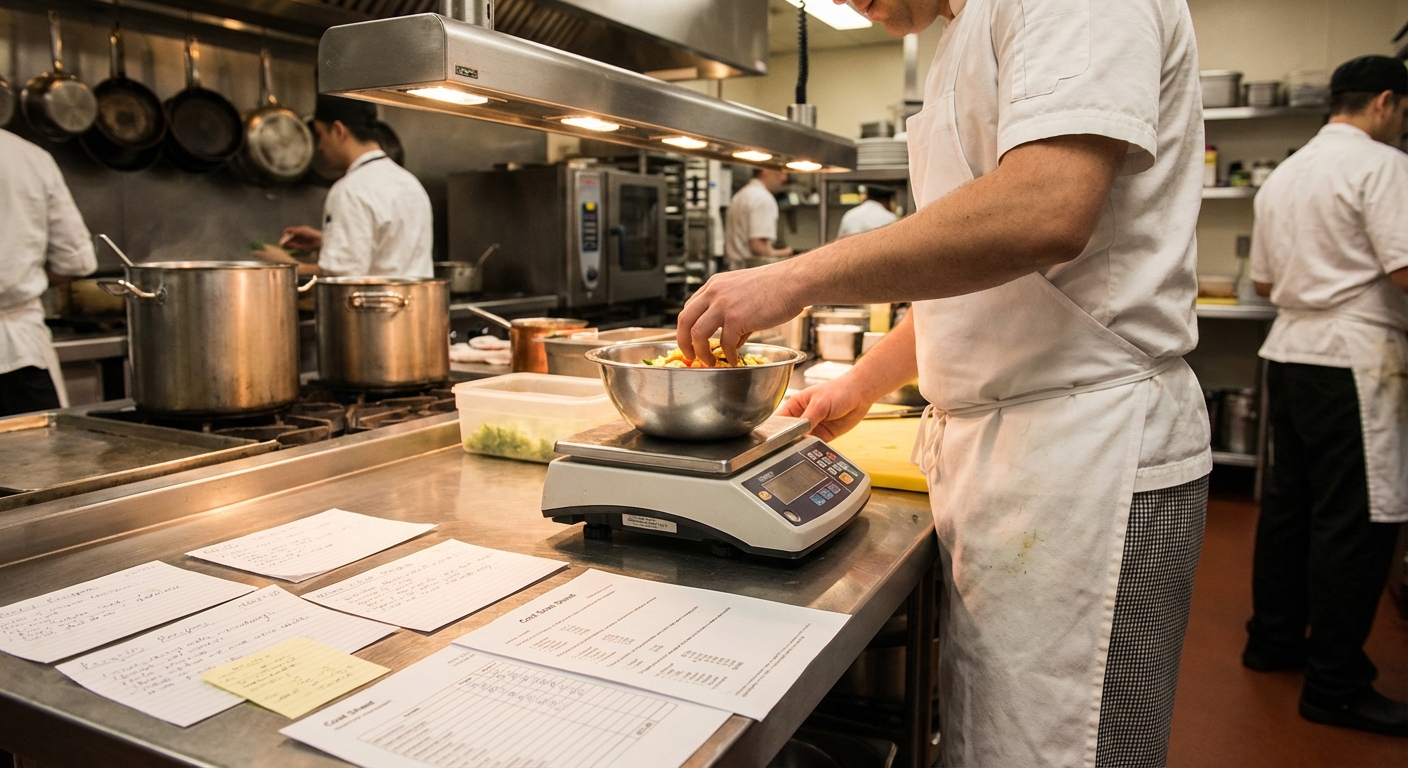
Use portion control tools. Scales, ladles, and portioning cups eliminate "handful" and "splash." A $30 portion scale at each station is one of the highest-ROI tools in your kitchen.
Hold recipe audits. Once a month, watch a cook make a dish from the standardized recipe and compare the finished product to spec. Address deviations immediately.
Tie it to accountability. When food cost runs high, pull out the standardized recipes and find the variance. Make the connection visible to the team.
Frequently Asked Questions
How many standardized recipes does a restaurant need?
Every dish on your current menu should have one. Start with your top-10 sellers by volume — those have the most financial impact. Build from there until every menu item is covered.
How often should I update my standardized recipes?
Any time ingredient prices change significantly (>10%), update your cost calculations. Any time you change your recipe, rewrite and re-cost it. Review the full recipe book quarterly.
Should my standardized recipes be public with staff?
The cost information is your business — you don't need to share per-portion cost with every line cook. The ingredients, portions, and preparation steps absolutely should be shared and enforced.
What's the difference between a standardized recipe and a spec sheet?
A spec sheet typically focuses on plating and presentation. A standardized recipe includes cost data and is the source of truth for both preparation and costing. Many restaurants maintain both.
Ready to take control of your food costs? Try CostLab free for 14 days →
Track Food Cost on Every Dish — Automatically
CostLab.AI calculates food cost percentage in real time. Update one ingredient price and see the impact across your entire menu instantly.
Start Free Trial →