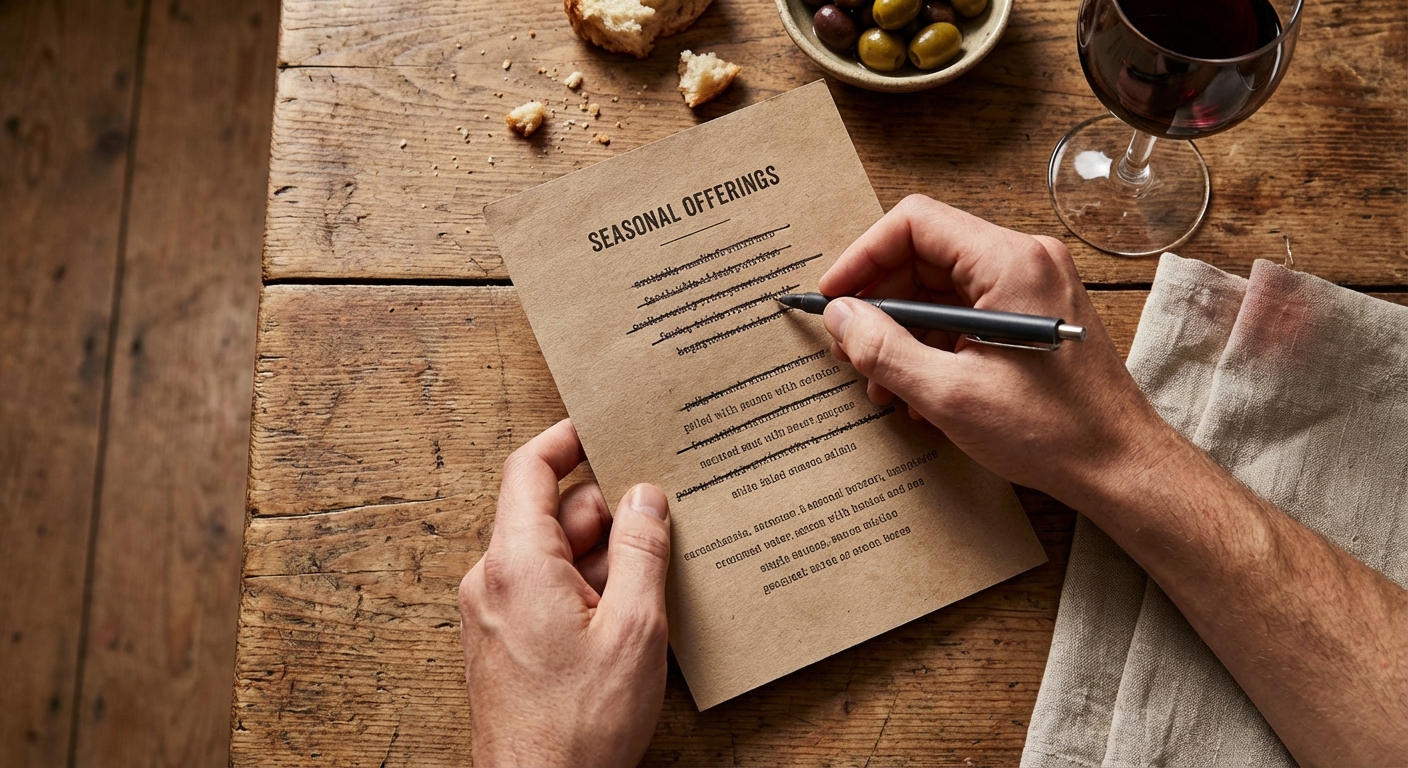
When to Remove a Menu Item (And How to Do It Right)
Every menu has items that should've been cut years ago. Here's how to identify which ones using food cost data and POS analytics—and how to remove them without upsetting regulars.
When to Remove a Menu Item (And How to Do It Right)
Removing a menu item is one of the most uncomfortable decisions a restaurant owner faces — and one of the most profitable. Every menu has at least one item that should have been cut two years ago. The dish that takes your prep cook an hour to assemble, that three regulars order religiously, and that your food cost spreadsheet quietly tells you is a problem.
Here's how to know when to cut — and how to do it without alienating loyal customers.
The 4 Signals It's Time to Remove a Menu Item
Signal 1: Food Cost Consistently Above 40%
A healthy food cost runs 28–35% for most concepts. If a dish is consistently above 40%, it's costing you money before labor, overhead, or waste is even factored in.
Your lamb shank is priced at $28. Plate cost is $12 — a 42.8% food cost. For every lamb shank you sell, you clear $16 before labor. If your kitchen takes 45 minutes to cook and plate it, and your line cook earns $18/hour, that's roughly $13.50 in labor per plate. You're left with $2.50 to cover all other costs.
That's not a restaurant dish. That's a charity.
Run your food cost on every item at least quarterly. When an item crosses 40% and you can't fix it with a price increase or recipe adjustment, it needs to go.
Signal 2: Bottom 10% of Sales for 3+ Consecutive Months
Pull your POS data. Sort items by unit sales over the last 90 days. Whatever's in the bottom 10% for three consecutive months is telling you clearly: guests aren't ordering it.
Low sales are expensive beyond just food cost:
- Ingredients sit in your walk-in and sometimes get thrown away
- Staff have to learn it, train on it, and talk guests through it
- Menu real estate wasted on something that earns you nothing
If an item hasn't broken the bottom 10% in three months, it's a candidate for removal.
Signal 3: High Kitchen Complexity Without Corresponding Price
A dish with 8 components, a 90-minute braise, and a 32% food cost might make sense if it sells well and generates strong margin per plate. The same dish with 8% sell-through is creating operational drag for minimal return.
Evaluate: How many components does it have? How long does it take to prep and plate? Is the menu price high enough to compensate for the kitchen time consumed?
Signal 4: Sourcing or Consistency Problems
An item requiring an ingredient you can only source seasonally, or that your current staff can't execute consistently, is a liability. If guests can't get the same dish every time, it damages your reputation even if the concept is excellent.
The Menu Engineering Framework
Before cutting, run a quick analysis:
| Category | Popularity | Margin | Action |
|---|---|---|---|
| ⭐ Star | High | High | Feature and protect |
| 🔵 Puzzle | Low | High | Reposition, promote |
| 🐎 Plowhorse | High | Low | Reprice or re-engineer |
| 🐕 Dog | Low | Low | Cut or redesign |
Dogs (low sales + low margin) are your clearest cuts. Plowhorses (popular but low margin) deserve a repricing attempt before removal. Puzzles (high margin, low sales) should get placement and promotion before the axe.
How to Remove a Menu Item Without Losing Regulars
Step 1: Don't Make It a Public Announcement
Don't post on social media that you're removing something. Announcements attract attention from the people who will miss it. Quiet removal is almost always better — most guests won't notice.
Step 2: Give It a 30-Day Runway
Mark the item as "seasonal" or "while supplies last" before it disappears. This softens the change for regulars and gives staff time to suggest alternatives.
Step 3: Train Staff on the Transition
Servers will get questions. Prepare them: "We rotated that off the menu, but [alternative dish] uses the same [key ingredient/flavor profile] and our regulars who loved it have really enjoyed it."
Never train staff to apologize for a menu decision. Be confident and redirect.
Step 4: Offer a Direct Alternative
If a regular asks, have a clear answer ready: "We don't have that on the menu anymore, but our [closest alternative] is similar — can I bring that out for you?" In exceptional cases, if you have the ingredients and the kitchen can execute it, you might accommodate for a loyal regular. But don't make a habit of it.
Step 5: Replace It With Something Better
Removing a Dog creates space — on the menu and in your kitchen's cognitive load. Fill that space with a new item engineered from the start for profitability: high margin, manageable prep, clear target market.
Frequently Asked Questions
How often should a restaurant review its menu for items to cut?
Quarterly. Run food cost on all items, pull 90-day POS sales data, and categorize in the menu engineering matrix. Annual reviews let bad items linger too long.
What if a low-profit item is a guest favorite?
Try fixing it first. Can you raise the price $2–3? Can you reduce one costly ingredient? If neither works and the item is genuinely unprofitable, selling it more hurts more than it helps.
Should I tell guests why an item was removed?
Keep it simple: "We updated our menu." If they press: "We focused the menu on what we do best" is a perfectly good answer.
How do I calculate food cost per menu item?
List every ingredient and recipe quantity. Find cost per unit from invoices. Multiply quantity × cost for each ingredient. Total the ingredients. Divide by the menu price. That's your food cost percentage.
Can removing menu items actually increase revenue?
Yes, consistently. Smaller menus reduce waste, lower prep complexity, allow staff to become experts on fewer dishes, and improve execution quality. Restaurants that trim from 50+ to 25–30 items typically see revenue per cover improve even if total sales volume stays flat.
Ready to take control of your food costs? Try CostLab free for 14 days →
Track Food Cost on Every Dish — Automatically
CostLab.AI calculates food cost percentage in real time. Update one ingredient price and see the impact across your entire menu instantly.
Start Free Trial →