Food Yield Percentage: Why Your Recipe Costs Are Probably Wrong
Understand food yield percentage and why it makes your recipe costs inaccurate. Includes the formula, real examples for common proteins, and how to fix your costing.
Food Yield Percentage: Why Your Recipe Costs Are Probably Wrong
Here's a mistake almost every independent restaurant owner makes: you cost out a recipe using the purchase price of your ingredients. Sounds reasonable. But it's wrong — and it's making your food cost look 10–30% lower than reality.
Food yield percentage is the key concept you're missing. This guide walks through the formula, real examples, and how to fix your costing immediately.
What Is Food Yield Percentage?
Food yield percentage is the amount of usable product you get after prepping and/or cooking an ingredient, expressed as a percentage of what you started with.
The formula:
Yield % = (Usable Weight After Prep ÷ Original Weight) × 100
If you start with 10 lbs of chicken breast and end up with 7.5 lbs of cooked, plated portions:
7.5 ÷ 10 = 75% yield
That 25% that disappeared is trim, moisture loss, and unusable scraps. But you paid for 100% of that chicken. Your real cost is based on what you actually use, not what you bought.
The Real Cost Formula
Once you know your yield %, you can calculate the Edible Portion Cost (what each usable pound actually costs you).
Edible Portion Cost = As-Purchased Price ÷ Yield %
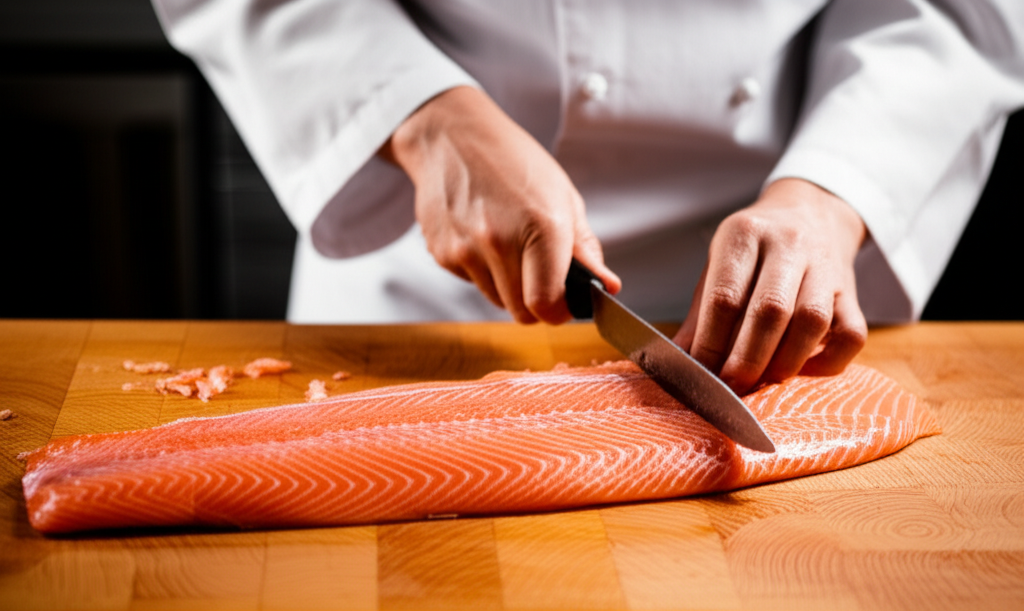
Example: Salmon Fillet
You buy salmon for $12.00/lb. After trimming skin and pin bones, you have 85% usable product.
$12.00 ÷ 0.85 = $14.12/lb — your real cost
A 6 oz salmon portion: 6 oz = 0.375 lbs × $14.12 = $5.30 per plate (just the fish)
Using the purchase price ($12.00/lb), you'd calculate $4.50 per portion. That's an $0.80 per plate error.
At 40 salmon covers a night, 5 nights a week: $832/month underestimating food cost on one menu item.
Common Yield Percentages by Ingredient
These are standard industry ranges. Always measure your own actual yields.
| Ingredient | Typical Yield % | Notes |
|---|---|---|
| Chicken breast (boneless) | 85–92% | Trim and moisture loss |
| Chicken breast (bone-in) | 65–70% | Bone removal + trim |
| Beef tenderloin (whole) | 70–75% | Trim, chain removal |
| Ground beef (cooked) | 70–75% | Cooking shrinkage |
| Salmon fillet | 80–90% | Skin, pin bones |
| Shrimp (shell-on) | 55–65% | Shell and deveining |
| Russet potatoes | 80–85% | Peeling and eyes |
| Carrots (whole) | 82–88% | Peel and trim |
| Romaine lettuce | 75–80% | Outer leaves, core |
| Onions | 88–90% | Peel and root |
How Cooking Method Affects Yield
Raw yield is only half the picture. Cooking changes weight too.
Roasting proteins: Chicken loses 20–30% of its raw weight when roasted. An 8 oz raw chicken breast becomes roughly 5.5–6 oz cooked.
Braising: Long-cook meats like short ribs or pork shoulder lose 30–40% during braising.
Sautéing vegetables: Most vegetables lose 30–50% water weight when cooked.
If you're costing a braised short rib dish, account for both the trim loss from butchering AND the moisture loss from cooking.
Running a Yield Test
A yield test is a documented measurement of how much usable product you get from a specific ingredient. Run one for every protein, fish, and high-cost produce item on your menu.
Step 1: Start with a consistent purchase unit (e.g., 1 case of bone-in chicken thighs) Step 2: Weigh the raw product before prep Step 3: Complete your prep (trim, portion, debone) Step 4: Weigh the usable product after prep Step 5: Calculate yield % = (after ÷ before) × 100
Run the test twice to confirm. Update costs in your recipe cards.
Why This Matters More When Prices Fluctuate
When commodity prices spike — beef up 20%, salmon up 30% — your actual portion cost increases faster than the as-purchased price suggests. Because you're only using 75% of what you bought, a $1 increase in as-purchased price means a $1.33 increase in your actual portion cost (at 75% yield).
Restaurants that don't account for yield get a nasty surprise when they recalculate menu prices after a supply chain shock.
FAQ
What is a normal food yield percentage for chicken breast?
Boneless skinless chicken breast typically yields 85–92% after trimming fat and silverskin. Bone-in drops to 65–70% after deboning. Always measure your specific product from your vendor.
How do I calculate edible portion cost?
Divide the as-purchased price per pound by the yield percentage (as a decimal). Example: $8.00/lb ÷ 0.80 = $10.00/lb edible portion cost.
Should I use raw weight or cooked weight for recipe costing?
Use cooked weight if you're portioning after cooking (sliced roast beef). Use raw weight if you're portioning before cooking (raw chicken breasts to order). Track yield at whichever stage you portion.
Conclusion
Accurate recipe costing is the foundation of food cost control — and yield percentage is what separates accurate costs from wishful thinking. Run three yield tests this week — your top three proteins. Update your recipe cards. The number you see will probably surprise you.
Ready to take control of your food costs? Try CostLab free for 14 days →
Track Food Cost on Every Dish — Automatically
CostLab.AI calculates food cost percentage in real time. Update one ingredient price and see the impact across your entire menu instantly.
Start Free Trial →