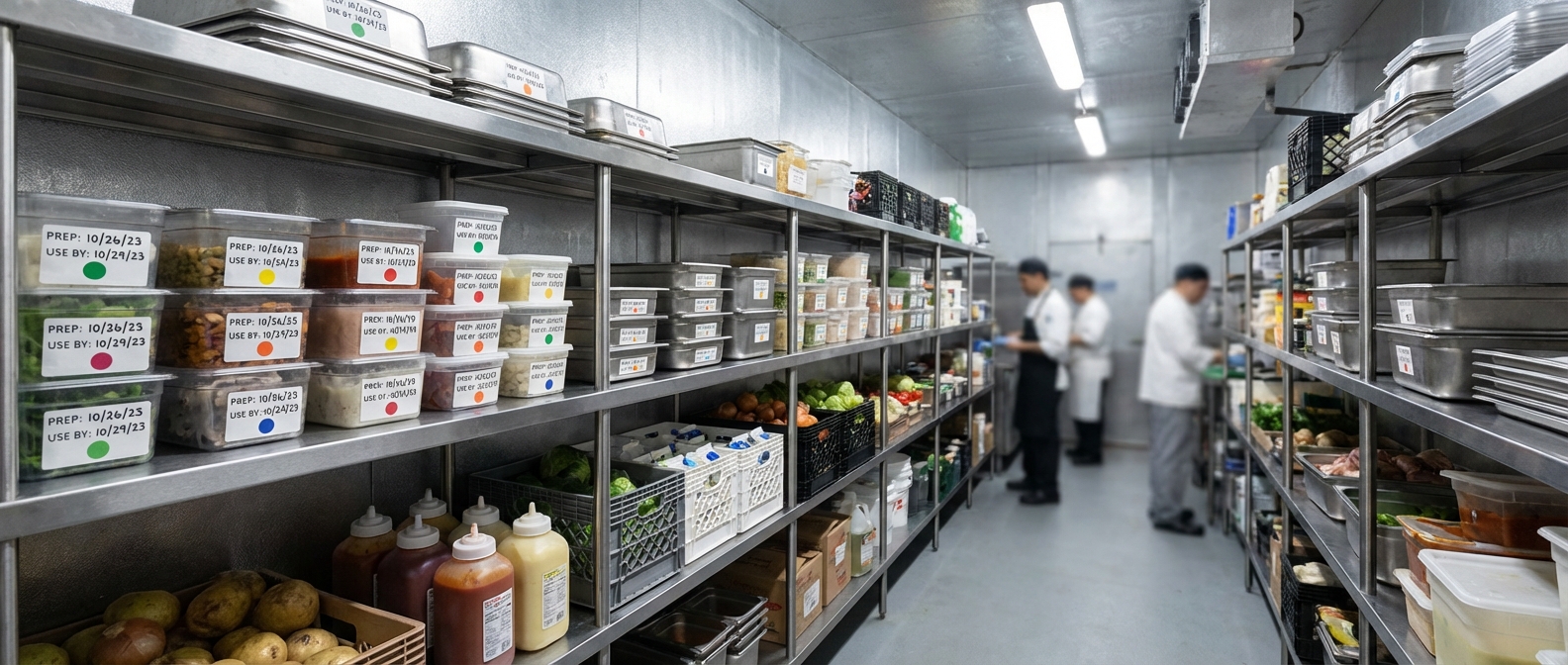
FIFO in Restaurants: How to Set Up First-In, First-Out
FIFO (First-In, First-Out) is the most effective food storage system for reducing waste and passing health inspections. Here's how to implement it correctly in your restaurant.
FIFO in Restaurants: How to Set Up First-In, First-Out
The FIFO system (First-In, First-Out) is the foundation of proper food storage in any restaurant. It means the oldest product is always used before newer stock — preventing spoilage, reducing food waste, and keeping you compliant with health codes. Despite being simple in concept, most independent restaurants implement FIFO inconsistently.
What Is FIFO and Why Does It Matter?
FIFO stands for First-In, First-Out. The item that entered your walk-in or dry storage first should be the first one used. New deliveries go behind existing stock, not in front of it.
Without FIFO, newer product naturally ends up in front because that's where it lands when received. Older product gets pushed to the back and forgotten until it expires.
The cost of poor rotation:
- Restaurants without consistent FIFO typically see 4–8% food waste from spoilage
- A restaurant with $400,000 in annual food purchases wastes $16,000–$32,000 without proper rotation
- Health inspectors specifically check for FIFO compliance — expired product in your walk-in is a violation
The 5-Step FIFO Implementation Process
Step 1: Date Everything on Delivery Day
The moment a delivery arrives, every case, container, and package gets a date label. This is non-negotiable.
- Use a label gun, date dots, or blue masking tape + marker
- Label with the date received and, for opened packages, the use-by date
- Standardize your format: MM/DD works for most operations
- Color-coded day-of-week dots from your restaurant supply store reduce errors and speed up the process
Step 2: Organize Storage Zones for FIFO Flow
Your walk-in, reach-ins, and dry storage should be physically arranged so older product is in front of newer product.
Walk-in organization:
- Receive new product on a separate cart
- Pull existing product forward before putting new product away
- New product goes behind existing stock — every time, without exception
Dry storage:
- Install shelving that allows stocking from the back (push-forward shelving or FIFO racks)
- Or simply enforce: new cans go behind old cans, new bags behind old bags
Step 3: Label Prepped and Opened Items
FIFO applies to everything that enters a cooler or dry storage:
- Prepped proteins and vegetables — Label with prep date and use-by date per health code timelines
- Opened cases — Mark the date opened on the container
- Made items — Soups, sauces, stocks — label with batch date and target use-by
- Portioned proteins — Show thaw date if applicable
Step 4: Assign a Daily Rotation Check
Designate one person per shift (typically the opening prep cook) to check date labels and verify product is being used in order. This takes 5–10 minutes and prevents the "forgot about it" spoilage events.
Daily walk-in check as part of opening tasks:
- Scan all shelves for anything expiring today or tomorrow
- Pull and move those items to the front
- Flag for the chef if they won't be used in time — can they be repurposed?
Step 5: Train and Reinforce
FIFO only works if everyone does it consistently. One team member who puts new product in front can undo the system.
Training essentials:
- Include FIFO in every new hire orientation
- Post a visual reminder inside walk-in doors ("New deliveries go IN BACK")
- Make it part of opening checklist that gets initialed
- Conduct a FIFO audit monthly — pull 3–4 random items and check: is the oldest product at the front?
FIFO by Storage Zone
Walk-in Cooler: Highest-risk zone. Organize by product category with clear zones. Proteins always on lowest shelves below ready-to-eat foods (also a health code requirement).
Reach-In Refrigerators (Line Fridges): Line cooks grab quickly under pressure. Pre-label pans with date of prep. During line setup, pull yesterday's pan to the front and put today's behind it.
Dry Storage: Lower urgency (shelf life measured in months), but FIFO still applies — especially for items with 90–180 day shelf life (oils, vinegars, dry goods).
Freezer: Frozen items rotate more slowly, but proteins and pre-made items should still follow FIFO. Label and date everything placed in the freezer.
Common FIFO Mistakes to Avoid
| Mistake | The Fix |
|---|---|
| Only dating deliveries, not prepped items | Label everything that enters a cooler or dry storage |
| Stacking new delivery in front of existing stock | Make rotation mandatory before stocking; have a receiving checklist |
| No consequences when FIFO is skipped | Make FIFO checks part of line opening duties requiring manager sign-off |
| Unclear date formats | Standardize to MM/DD, train everyone |
| Not training new hires | Make FIFO part of day-one orientation, in writing |
Frequently Asked Questions
What is the FIFO rule in restaurants?
FIFO means First-In, First-Out — older stock is used before newer stock. New deliveries are placed behind existing inventory so older product is always grabbed first.
Is FIFO required by health code?
Most health codes require proper date labeling and food stored to prevent spoilage — FIFO is the standard methodology. Health inspectors often test for it specifically by checking whether older items are at the front of storage.
How long does it take to implement FIFO?
The physical setup can be done in a single day. Building the consistent habit takes 4–6 weeks of active reinforcement.
What labels should I use for FIFO?
Options: adhesive date dots (color-coded by day), label tape + Sharpie, or a commercial label gun. Many operators use blue painter's tape — cheap, easy to write on, and leaves no residue on containers.
How does FIFO reduce food costs?
FIFO prevents product from expiring before it's used. Less spoilage = less waste = lower actual food cost. Combined with a waste log, FIFO is typically one of the two highest-impact food cost control practices for independent restaurants.
Ready to take control of your food costs? Try CostLab free for 14 days →
Track Food Cost on Every Dish — Automatically
CostLab.AI calculates food cost percentage in real time. Update one ingredient price and see the impact across your entire menu instantly.
Start Free Trial →