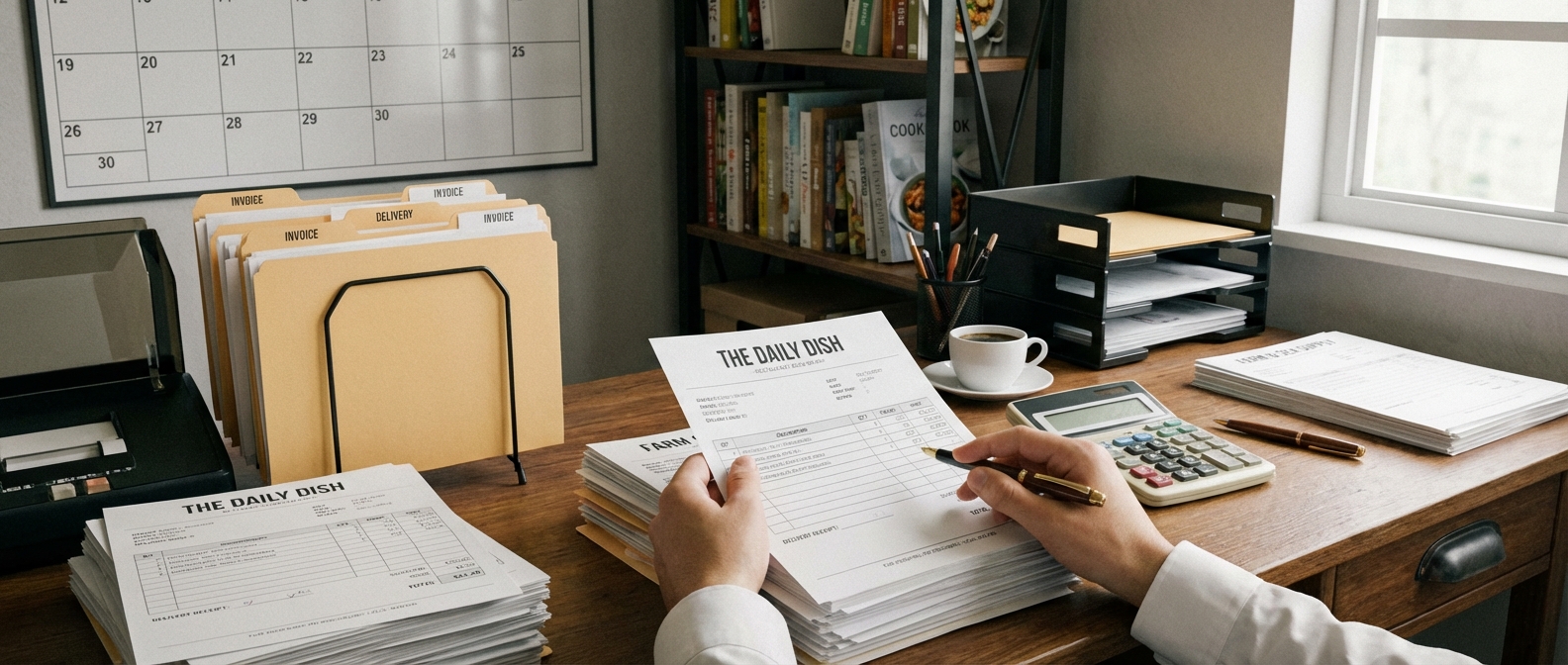
Restaurant Invoice Reconciliation: Catch Billing Errors Fast
Vendor billing errors cost restaurants thousands annually. A consistent invoice reconciliation process catches overcharges, short shipments, and price creep before they drain your margins.
Restaurant Invoice Reconciliation: Catch Billing Errors Fast
Restaurant invoice reconciliation is the process of verifying that what you were charged matches what you actually ordered and received. Billing errors, price discrepancies, and short shipments are more common than most operators realize. A restaurant doing $1 million in annual food purchases can easily lose $15,000–$30,000 per year to unreconciled invoices.
Why Invoice Errors Are So Common
Restaurant purchasing is fast, high-volume, and often handled by multiple people. The conditions that create billing errors:
- Price fluctuations — Your PO was written Monday; delivery arrives Thursday at last week's price. Or the new price.
- Substitutions — A driver delivers a different brand or size than ordered. The invoice charges for the substitute at a different price.
- Weight discrepancies — Items priced by weight (produce, protein) are sometimes delivered short. A case of chicken billed at 40 lbs but weighing 37.5 lbs is a quiet $4–$8 per case error.
- Duplicate charges — A credit for returned product doesn't get applied; you're charged twice.
- Manual entry errors — Order guides and invoices involve a lot of numbers entered by humans. Mistakes happen.
Most of these errors aren't intentional fraud. But they're real money leaving your business.
The Invoice Reconciliation Process
Step 1: Start with a Purchase Order or Order Guide
Every order should be placed from a written PO or order guide — even a typed list in your notes app. This is your "what I expected" document. Without a PO, you have nothing to compare the invoice against.
Step 2: Receive Deliveries Properly
- Count every case. Don't just sign and let the driver leave.
- Weigh protein and produce. Random weight items need to be spot-checked.
- Note substitutions immediately — write on the invoice what was substituted.
- Refuse items that don't meet spec — wrong brand, wrong size, damaged packaging. Mark the invoice.
- Never sign an invoice you haven't reviewed, even if the driver is in a hurry.
Step 3: Compare Invoice to PO and Receiving Notes
Within 24 hours of delivery, compare:
| Check | What to Look For |
|---|---|
| Quantities | Did you receive what was invoiced? |
| Units | Cases vs. each vs. pounds — easy to mix up |
| Prices | Does invoice price match your contract/quote? |
| Substitutions | Is the subbed item priced correctly? |
| Credits | Were any prior credits applied? |
Flag any discrepancy above $5. Track everything — even small ones tell you who's billing accurately.
Step 4: Log Discrepancies and Contact Vendor
Keep a running discrepancy log:
| Date | Vendor | Invoice # | Item | Expected | Actual | Difference | Status |
|---|---|---|---|---|---|---|---|
| 3/5 | US Foods | 884421 | Chicken breast | $2.40/lb | $2.68/lb | -$8.40 | Credited |
| 3/7 | Sysco | 992103 | Olive oil | 4 cases | 3 cases | -$42.00 | Short ship filed |
Contact your rep immediately. Most distributors have a credit window of 24–72 hours after delivery.
Step 5: Reconcile Statements Monthly
At month-end, reconcile your vendor statement to your invoices and credits. Ensure:
- All invoices are accounted for
- All promised credits appear on the statement
- No already-paid invoices appear as outstanding
How to Use Discrepancy Data Strategically
Your discrepancy log reveals:
- Which vendors have the most billing errors — useful in contract renegotiations
- Which items have price volatility — these need tighter monitoring
- Whether a particular delivery driver is consistently short-shipping — worth flagging with your rep
If one vendor generates 10 discrepancies per month totaling $200+, that's a conversation worth having — or a reason to evaluate alternatives.
Tools for Invoice Reconciliation
| Approach | Best For | Tools |
|---|---|---|
| Manual (spreadsheet) | Small operators | Google Sheets, paper log |
| Software | Mid-size and growing | MarketMan, BlueCart, xtraCHEF |
Frequently Asked Questions
How common are billing errors in restaurant invoicing?
Industry estimates suggest 3–8% of invoices contain some form of discrepancy. For a restaurant with $400,000 in annual food purchases, that's potentially $12,000–$32,000 in overbilling risk per year.
Who should be responsible for invoice reconciliation?
The kitchen manager or chef handles receiving and immediate invoice review. The owner or bookkeeper does monthly statement reconciliation. Clear ownership matters — when it's everyone's job, it becomes no one's job.
What's the fastest way to catch price creep from vendors?
Create a price benchmark sheet for your top 30 items — the price you expect to pay, updated quarterly from your contract or last confirmed quote. Run every invoice against these benchmarks.
Should I accept substitutions from vendors?
Document it on the delivery invoice the moment you accept or reject it, and verify the price charged for the substitute is fair.
How do I handle a vendor that repeatedly overbills?
Document every instance. Request a formal meeting with your rep. If errors continue, use documentation as leverage in contract renegotiation or to justify switching vendors.
Ready to take control of your food costs? Try CostLab free for 14 days →
Track Food Cost on Every Dish — Automatically
CostLab.AI calculates food cost percentage in real time. Update one ingredient price and see the impact across your entire menu instantly.
Start Free Trial →