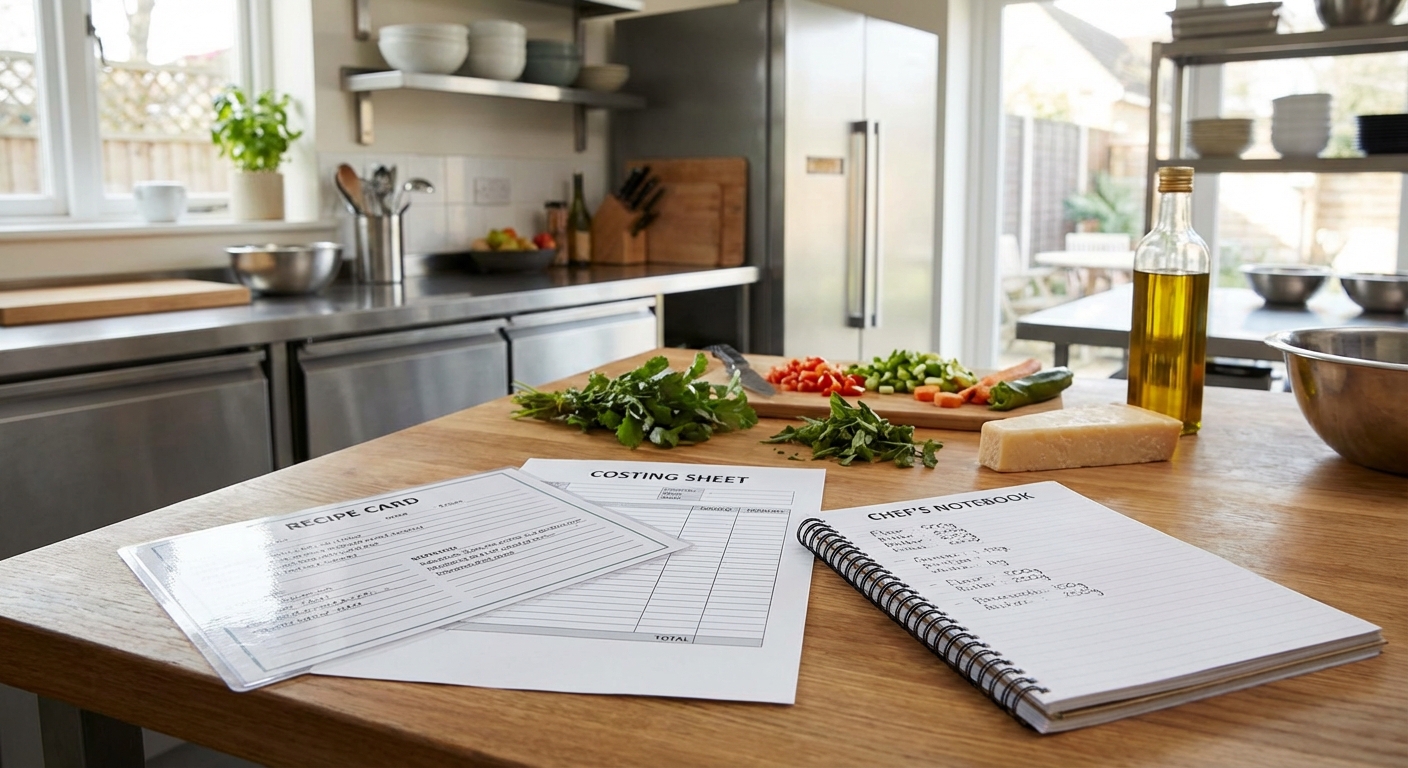
Restaurant Recipe Card Template: Cost Every Dish
Build a restaurant recipe card template that tracks ingredient costs, portion sizes, and food cost percentage for every dish on your menu.
Restaurant Recipe Card Template: Cost Every Dish
Every restaurant recipe card is a standardized, costed document that controls your food quality and food cost simultaneously. Without recipe cards, your margin is a moving target — changing every time a different cook is on the line. Here's how to build recipe cards that actually work, complete with a template you can use today.
What You Have vs. What You Need
Most restaurants don't have recipe cards. They have something worse: tribal knowledge — the chef knows the dish, the sous chef has a rough idea, and the line cook is guessing on portion size.
Tribal knowledge means your food cost is unpredictable. It means every time someone new cooks your signature dish, your margin changes. A recipe card fixes all of this.
The 8 Fields Every Recipe Card Needs
1. Dish Name — The exact name from your menu. No nicknames.
2. Portion Size — Specific weight or volume as plated. Example: 6 oz salmon fillet + 4 oz risotto + 2 oz sauce.
3. Ingredients (with exact weights) — Every ingredient, measured by weight, not volume.
4. Preparation Method — Step-by-step instructions specific enough that a new cook could follow them without asking questions.
5. Plating Instructions — Where the protein goes, how the sauce is applied, which garnish and in what position.
6. Yield — The recipe's output. If a batch makes 10 portions, yield = 10.
7. Total Recipe Cost — Sum of every ingredient's cost at exact usage quantities.
8. Cost Per Portion — Total recipe cost divided by yield. The number you use to calculate food cost percentage.
A Real Recipe Card: Pan-Seared Salmon with Lemon Risotto
Dish: Pan-Seared Salmon with Lemon Risotto Portion: 1 plate (6 oz salmon, 5 oz risotto, 1.5 oz sauce) | Yield: 1 portion
| Ingredient | Weight | Unit Cost | Extension |
|---|---|---|---|
| Atlantic salmon fillet | 7 oz (raw) | $0.75/oz | $5.25 |
| Arborio rice | 2 oz dry | $0.08/oz | $0.16 |
| Chicken stock | 6 oz | $0.04/oz | $0.24 |
| Shallot, minced | 0.5 oz | $0.12/oz | $0.06 |
| Lemon juice (fresh) | 0.4 oz | $0.20/oz | $0.08 |
| Parmesan, grated | 0.5 oz | $0.45/oz | $0.23 |
| Butter, unsalted | 0.6 oz | $0.28/oz | $0.17 |
| Olive oil | 0.3 oz | $0.22/oz | $0.07 |
| Heavy cream | 1 oz | $0.18/oz | $0.18 |
| Dill (garnish) | 0.1 oz | $0.60/oz | $0.06 |
| Salt, pepper | — | — | $0.05 |
| Total Recipe Cost | $6.55 | ||
| Selling Price | $26.00 | ||
| Food Cost % | 25.2% |
When ingredient prices change, update the unit cost column and the food cost percentage adjusts automatically.
Why Weight Beats Volume Every Time
A "cup" of chopped fresh dill can weigh anywhere from 0.5 oz to 1.5 oz depending on how tightly it's packed — a three-fold difference in cost. An ounce of chopped fresh dill is always an ounce.
Weight measurements eliminate the variability that volume measurements allow. Buy a kitchen scale that reads in both ounces and grams. Make weight the standard for everything except liquids measured by the liter.
How to Build Recipe Cards for Your Whole Menu
Don't try to do all 60 dishes at once. Prioritize:
- High-volume items — your top 10 sellers by cover count
- High-cost items — dishes with the most expensive proteins or specialty ingredients
- Menu items with inconsistent food cost — dishes where cost % seems to change month to month
Assign one or two dishes per day to the chef. It takes 15–20 minutes per card. Work through the full menu over 4–6 weeks.
Keeping Recipe Cards Updated
A recipe card with last year's prices is a false comfort. The cost per portion is wrong, and you don't know it.
Quarterly review process:
- Pull current prices from distributor invoices
- Update the unit cost column for each affected ingredient
- Recalculate cost per portion
- Flag any dish whose food cost % moved more than 2 points
- Decide: adjust price, adjust portion, or substitute an ingredient
This takes 2–3 hours per quarter. The cost of not doing it: running dishes at 38% food cost while thinking they're at 30%.
FAQ: Restaurant Recipe Cards
What should a restaurant recipe card include?
Every recipe card should include dish name, portion size, ingredient list with exact weights, prep method, plating instructions, yield, total recipe cost, and cost per portion. These eight fields give you both quality control and cost control.
How do I calculate food cost percentage on a recipe card?
Divide the total recipe cost by the selling price, then multiply by 100. Example: $6.55 cost ÷ $26.00 selling price × 100 = 25.2% food cost.
How often should I update recipe card costs?
Update ingredient prices quarterly at minimum — or immediately after any major price change from your suppliers. Set a calendar reminder every 90 days.
What's the difference between a recipe card and a recipe?
A recipe tells you how to make a dish. A recipe card tells you how to make it, what it costs, and what it should sell for. The costing information is what makes it a management tool.
Ready to take control of your food costs? Try CostLab free for 14 days →
Track Food Cost on Every Dish — Automatically
CostLab.AI calculates food cost percentage in real time. Update one ingredient price and see the impact across your entire menu instantly.
Start Free Trial →